What kind of curator do I want to be?:The circular production of affective labour, dismantling/replicating the curatorial hierarchies.
This is the Essay I submitted for the module ‘Curating, Education and Research’ in the academic year 2023-2024. This report reflects on the project we collaborated on with Fine Art Students in Semester 1. Grades, feedback, and my reflections are at the end.
“According to theorist Paolo Virna, post-Fordist capitalism, with its emphasis on flexibility, has led to an expansion of “living labour,” such that not only all of our working hours, but our very desires and thoughts have been absorbed into new regimes of work.” - Julian Bryan-Wilson in ‘Occupational Realism’[1]
“…Arika (2015) asked: ‘if contemporary life leaves us feeling ill, exhausted and uncared for, how might we care for each other differently?’” - Helena Reckitt in ‘Support Acts: Curating, Caring and Social Reproduction’[2]
Introduction
Oxford English Dictionary defines the curator as, “the official in charge of a museum, art gallery, library, or other such collection; a keeper, custodian.”[3] Tate describes the curator as, “someone employed by the museum or gallery to manage a collection of artworks or artefacts” their job is “to acquire, care for and develop a collection.” Acknowledging the changing role of the curator, rebranding precarity as “non-attachment,” market requirement of individuality and out of the box ideas as “idiosyncratic ways of making exhibitions.”[4]
Oxford dictionary definition makes transparent the social production of the curator; someone whose role is overstated in the hierarchy of artistic production. Tate’s description places the curator as a cog in a larger institutional machine, more realistic and honest about what the curator is now. However, the strategic re-branding of the curator on Tate’s part as a kind of freelance creative in their own right does highlight their lack of acknowledgement of the affective labour- a term explained by Helena Reckitt -on the curator’s part. Thinking on these lines I wondered about the kind of curator I wanted to be while exploring the role of the curator in the assembly line of cultural work during the first semester.
In week 4, Charlotte mentioned “travail a la chaine” unable to recall the English translation. A term perfectly defining our discussion about the way everything and everyone was put into categories that came before and after each other. The framework of the institution obfuscating collective oppressions by creating deliberate devisions between these categorised people. This line of thinking began with the observation of how divided Fine Art and Art History (FAHA) students, Art History students and the Curating students were. Naturally leading to reflecting on the erasure of maintenance labour undertaken by various people in the art world. Through this came the title, ‘Looking Back through the Assembly line,’ a process of critically reflecting on the role of the curator, and to witness all who exist before and after the curator and artist in the assembly line of the art world. The way our facilitation group chose to explore this was through making zines individually amongst ourselves, building that into a collective zine, then taking photocopies of the zine, asking the audience to build with and over these photocopies of our zines.
Body
Soyini Madison’s ‘Introduction to Critical Ethnography’ is being used as a framework of critically reflecting on the activities, the workshops and the conversations that happened between the tutors (Ali and Francesca), the curating students (Tiffany, Charlotte, Viktorija and I) and the art students/practitioners (Kushboo, Ya-Hsuan and Fercop) who worked with our group. Grounding the reflection in my experience and recollection of how the semester transpired.[5]
How did the semester the transpire?
Week 1: Outline of module and semester. Introducing APR (A Particular Reality), its role in navigating a relationship between platforming BIPOC artists while working in a collaborative and non-hierarchical way.
Week 2: Lecture surrounding topics like collectives, sociability, creation of solidarity amongst marginalised communities. Problematising notions of authorship, usage of Collective by institutions like Tate and thinking about sustainable formats of collectivity and art making.
Week 3: Introduction to different forms of research methodologies, action research in the centre of it. Thinking about strategies like ‘Naming the Moment.’ Formation of our individual facilitation group at the end of the class.
Week 4: Assessment criteria, the individual facilitation groups were asked to develop an idea responding to a shared injustice and/or marginalisation. Asked to think about working on a call out that needed to be submitted by Monday for the tutors to circulate through APR channels. During a zoom call the next day our group came up with ‘Looking back through the assembly line.’
Week 5: We participated in an activity about collaboration. There was music played in the background, people were asked to be in groups of two on three. They would draw on the paper without lifting the pen tip, instinctively responding to the music. This was done 4 times, the paper decreasing in size progressively. Continued with introduction to radical educational practices like Paulo Freire with examples of radical art pedagogical practices.
Week 6: Art students/practitioners were amongst us on this day. Lecture session was about how the curating students could engage with the artists, how to interpolate their art practices into our idea. We visited Fercop’s art studio, Ya-Hsuan and Kushboo introduced their practice through an online portfolio as their studios were too far. The artists were very invested in making a zine.
Week 7: We were made aware of the spaces available for our facilitations/exhibitions with the plan to visit those space with the whole class, and told the process of administrative tasks like ordering art materials. Deadline for the submission of our poster was announced. Our group chose to separate ourselves from the class a little earlier to have a longer conversation with the artists about their experience regarding division in the art world. Some of the things that we spoke about were the blurring of lines between artistic and curatorial practices but also the rigidity they maintain in an institutional way. The artist can curate a show but doesn’t become a curator and vice versa. Also thinking through the power dynamic between the artist and the curator, the artisan and the artist, so on and so forth.
Week 8: A facilitation schedule was announced, list of decisions to be made were put forth, lecturers put forth certain technical details that we needed to think about. We decided to individually make at least a zine sheet, record ourselves while making it to make a video to be run in the background. We would meet in the following week before the facilitation to combine the zine and think through our facilitation details.
Week 9: There were two facilitations during this day. Our facilitation was during the second half of the day. The entire day was a part of our class.
Week 10: There was one facilitation, a reflection session and an exhibition opening at the end of the day. The entire day was a part of our class.
Why Zine?
Zines have historically been utilised by the subaltern counter public sphere as a method of mobilising, sharing knowledge and entertainment. The zine Vice Versa is an example of this. Vice Versa is presumed to be the first queer zine made by Edythe Eyde for a lesbian audience. It was illegal to distribute material pertaining to homosexuality through the U.S. Postal Service as it was considered obscene content. In between June 1947 to February 1948 Edythe made copies to circulate the zines amongst her friends, her friends sharing it with theirs.[6] The ease and immediacy of manufacturing a zine allows the subaltern counter public sphere to create its own form of archive without needing to jump through the hurdles of traditional publication. This is something that is observed through Drew Sawyer and Branden Joseph’s exhibition, ‘Copy Machines Manifestos.’ Art historians and co-curators Drew and Brandon gathered over 800 zines starting from late 1960s creating a map of these resistances while understanding their role as an archive.[7]
Reflection of the semester
Perhaps a good place to start is to reflect on the classroom space. The classes were structured into two blocks starting with lecturers imparting knowledge followed by an activity allowing for conversation amongst students. The lecture space had an activist/interventionist voice. The teaching centred around injustice and/or marginalisation in the art world and the ways in which others have responded through collaboration.[8] The tutors were making as much an intervention as we were being asked to. The affective labour on their part influencing the affective labour of the curating students and the artists. Affective labour, borrowed from Helena Reckitt, means immaterial labour like curatorial work produces or influences feelings. A form of motivating people and communities around them through their affective charm.[9] Paulo Freire introduces problem solving methodology of education in the ‘Pedagogy of the Oppressed,’ stating that modes of education then (and even now) create receptacles of knowledge, or train people to think a certain way which he states is the banking system. In resistance to this method of learning problem-solving education is proposed. Problem solving is essentially to question what is being taught and not just learn it in a passive manner. The liberatory practice of education that is problem-solving needs a grounding in context. That grounding in context is the banking system. These two system are a form of extremes in the way they were codified by Freire. What if we think about the affective charm of the tutors as a form of banking system, the criteria of facilitation as a form of problem solving.[10] What needs to be factored into this is timeline.
The groups formed at the end of class in week 3, week 4 there was clarity in terms of what was expected of us, by the Monday of week 5 we had to submit a call out proposal to the lecturers. Week 6 we had artists amongst us. Week 6, 7 and 8 was all the time we have to finalise what we wanted to do in week 9. While our group was getting to know each other we were also thinking about administrative tasks like the what, who, where, when, how and why. Simultaneously unpacking the glaring problematic in our methodology. If our idea is based in the isolation in the art world, how it doesn’t allow for collaboration, to critically reflect on the role of the curator and their place in the hierarchy, the curating students choosing an idea for the artists who came in later to develop still builds on the same pyramidal structures. This was where there was an overlap in the methodology of the tutors and the methodology of our group. During the previous classes the tutors had spoken at length about the marginalisation of the artist voice when it comes to curatorial frameworks, collaboration a form of resistance to it. However, at what point should the collaboration start? One could argue that the artist picking the group they wished to work with is allowing them autonomy over the process. However, autonomy over the process does not negate the hierarchy. The same can be said about the dynamic between the curating students and the prompts for the graded facilitations to be held at the end of the semester. Autonomy over what can be decided on an individual group level does not negate hierarchy. Examples of this: while material was given for the call out by the curating students a lot of it was reinterpreted into a google form by the lecturers. Content posted on instagram through APR was collated by the lecturers. At what time and when the groups would conduct their various facilitations was proposed by the tutors. The order for the art materials that were needed was collated by the individual groups but placed by the tutors and later collected by the tutors as well. The group poster for the entire exhibition was made by the tutors, ‘Inquiries’, a title they came up with.
Unsustainable timelines produce carers without considering the capacities of the carers. The curating student caring for the artist, the tutor caring for the curating students, all of them forced to do burn out inducing work without reflecting on how liberatory practices mean very little if we are not there to see it at the end.
Conclusion
Andrea Fraser talks about the individual (the artist) as an institution in ‘From the Critique of Institutions to Institution of Critique.’ It is a cautionary to reflect on where we operate in the institution, what we dismantle and replicate. We exist in the institution, whatever we do we exist in it, we are it, we cannot run away from it. If we try to, even the process of running becomes an institution. Then the only way is to have personal accountability and understanding of how we are dismantling and replicating it.[11]
On that note, I’m going to conclude with unpacking the question, “what kind of curator do I want to be?” I want to be the curator who collects, upholds, gives space to the copy machine manifestos while creating communities of care. Thinking about why these copy machine manifestos need to exist, holding the institution accountable while trying to create institutional change. Making sustainability, care practices and reflective practices a central tenet in my artistic and curatorial practice. Remembering that those tenets are not only for the other but also for myself.
Footnotes
[1] Julian Bryan-Wilson, “Occupational Realism,” 34.
[2] Helena Reckitt, “Support Acts: Curating, Caring and Social Reproduction,” 16.
[3] “Curator,” Oxford English Dictionary, Accessed March 1, 2024, https://www.oed.com/.
[4] “Curator.” Tate, Accessed March 1, 202, https://www.tate.org.uk/art/art-terms/c/curator.
[5] Soyini Madison, “Introduction to Critical Ethnography, Theory and Method,” 5-8.
[6] “Zine.” Encyclopædia Britannica, last modified, November 29, 2023, https://www.britannica.com/topic/zine.
[7] Veronica Esposito, “‘Still a Very Alive Medium’: Celebrating the Radical History of Zines,” The Guardian, November 28, 2023.
[8] Soyini Madison, “Introduction to Critical Ethnography, Theory and Method,” 5-8.
[9] Helena Reckitt, “Support Acts: Curating, Caring and Social Reproduction,” 6–30.
[10] Paulo Freire, “Chapter 2.” In Pedagogy of the Oppressed, 71–87.
[11] Andrea Fraser, “From Critique of Institution to Institution of Critique,” Artforum, September 26, 2023, https://www.artforum.com/features/from-the-critique-of-institutions-to-an-institution-of-critique-172201/.
Bibliography
Bryan-Wilson, Julia. “Occupational Realism.” TDR/The Drama Review 56, no. 4 (December 2012): 32–48. https://doi.org/10.1162/dram_a_00212.
Esposito, Veronica. “‘Still a Very Alive Medium’: Celebrating the Radical History of Zines.” The Guardian, November 28, 2023. https://www.theguardian.com/artanddesign/2023/nov/28/zines-exhibition-brooklyn-museum-art.
Fraser, Andrea. “From the Critique of Institutions to an Institution of Critique.” Artforum, September 26, 2023. https://www.artforum.com/features/from-the-critique-of-institutions-to-an-institution-of-critique-172201/.
Freire, Paulo. “Chapter 2.” In Pedagogy of the Oppressed, 71–87. London : Continuum, 2005.
Home : Oxford English Dictionary. Accessed March 1, 2024. https://www.oed.com/.
Kranzberg, Melvin, and Michael T. Hannan. “History of the Organization of Work.” Encyclopædia Britannica, May 18, 2023. https://www.britannica.com/topic/history-of-work-organization-648000.
Madison, Soyini D. “Introduction to Critical Ethnography, Theory and Method .” Essay. In Critical Ethnography: Method, Ethics, and Performance, 1–15. Los Angeles, CA: SAGE Publications, Inc, 2012.
Matthias, Meg, and Rene Ostberg. “Zine.” Encyclopædia Britannica, November 29, 2023. https://www.britannica.com/topic/zine.
Reckitt, Helena. “Support Acts: Curating, Caring and Social Reproduction.” Journal of Curatorial Studies 5, no. 1 (February 1, 2016): 6–30. https://doi.org/10.1386/jcs.5.1.6_1.
Tate. “Curator.” Tate. Accessed March 1, 2024. https://www.tate.org.uk/art/art-terms/c/curator.
Appendix
Note: Some pictures in the Appendix that were submitted for the assignment have been removed to protect the identity of the people working on this project.
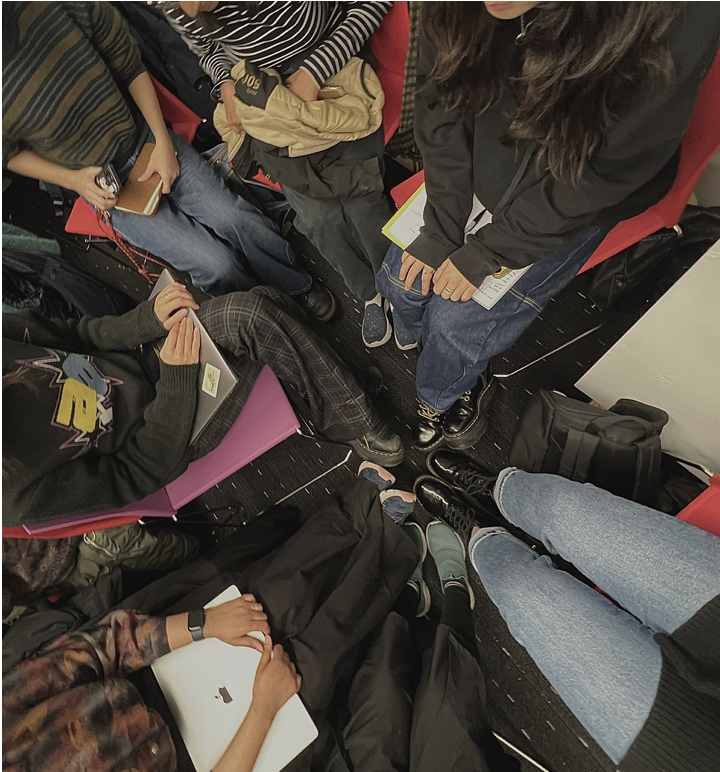
Appendix C: The first time we met the artists in week 6
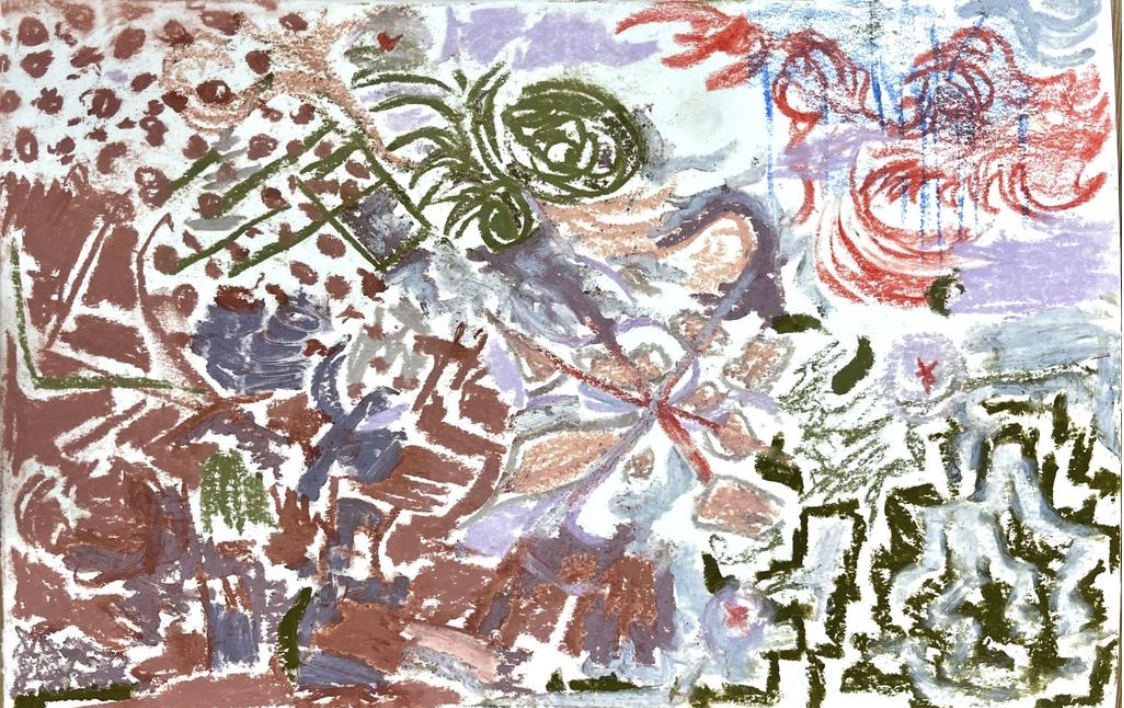
Appendix D: In Week 7 Charlotte, Fercop and I instinctively drew on this paper while having conversations about lack of opportunities to collaborate with other departments.
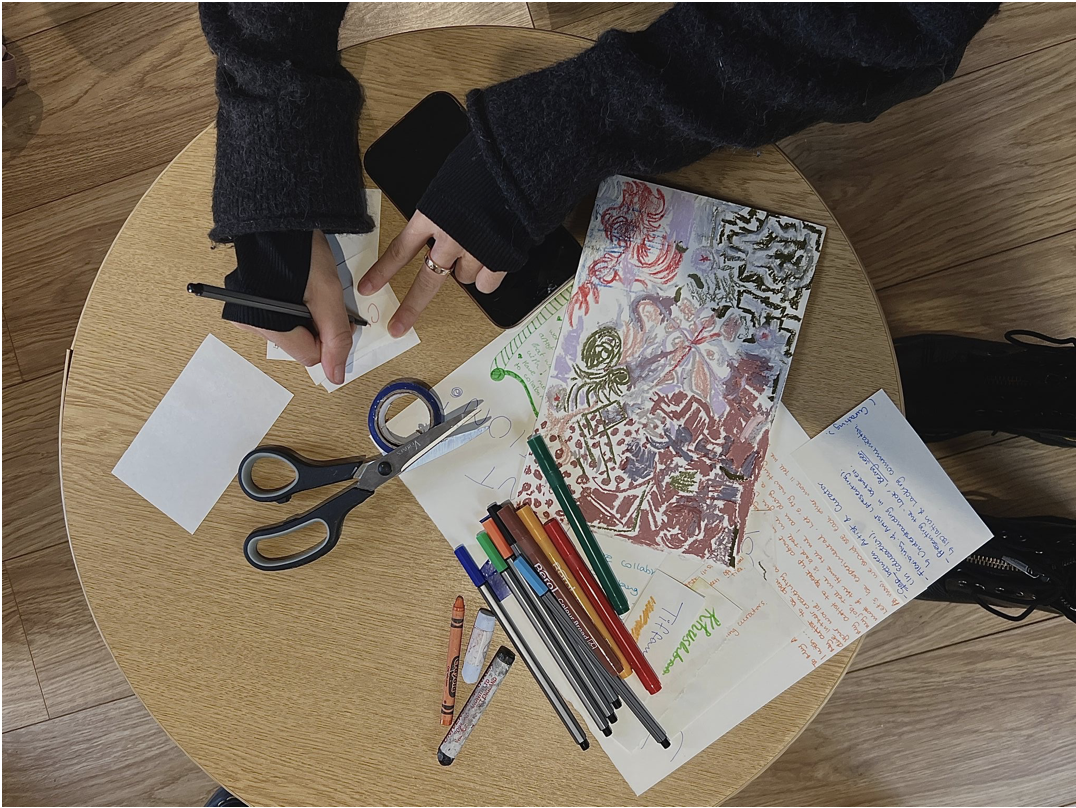
Appendix E: Materials we made while having conversation in week 7.
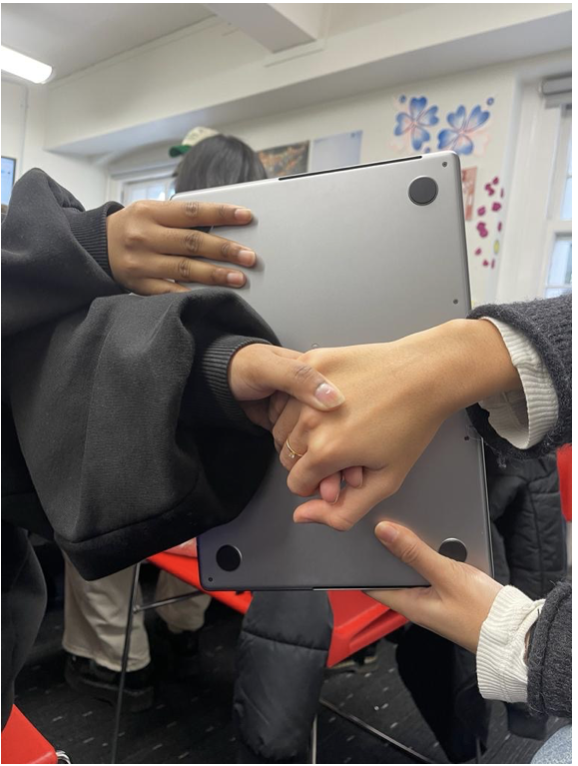
Appendix G: Charlotte and I did not want to get up to stand in front of a clean background so we held up my laptop behind our hands. It didn’t work, we had to get up.
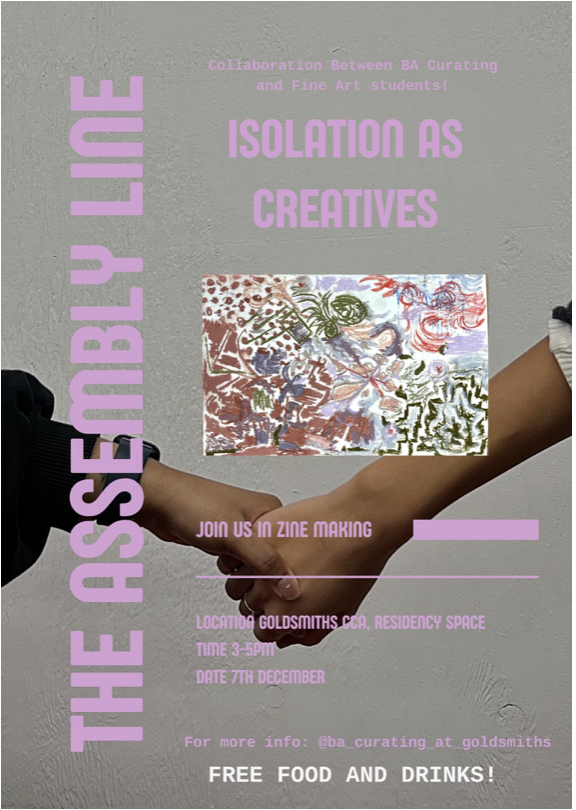
Appendix H: The poster for the facilitation created in week 8.
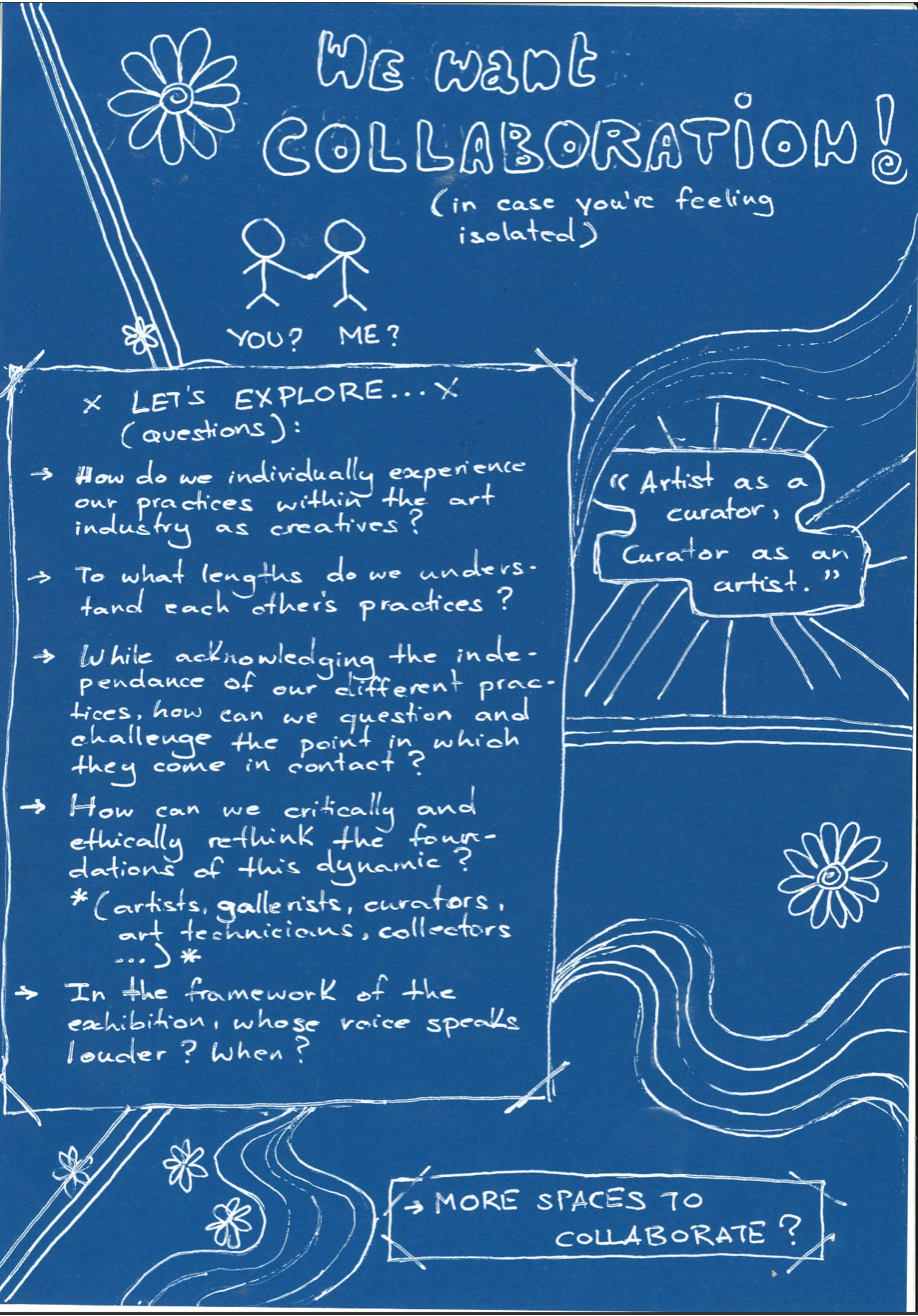
Appendix I: Charlotte’s Zine page.
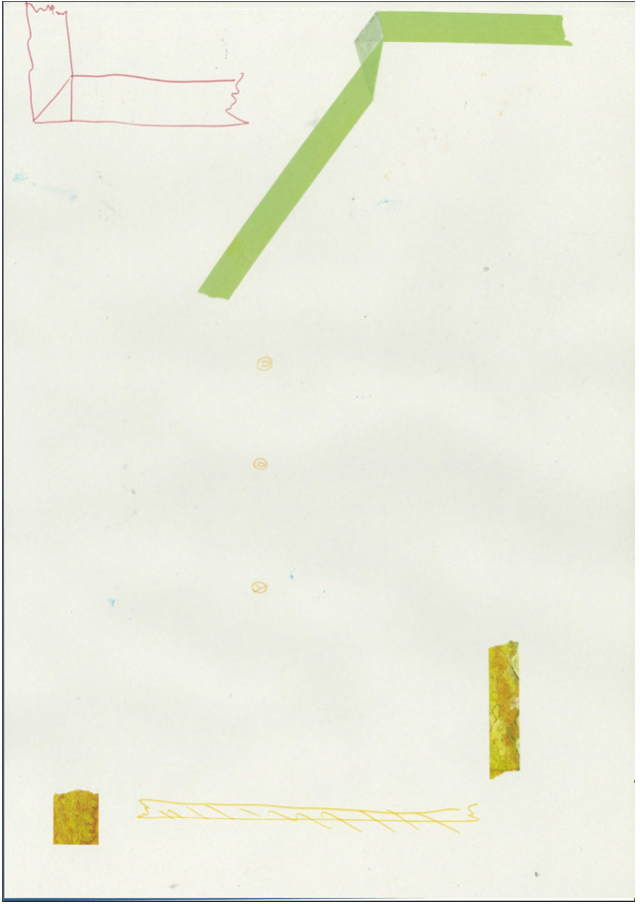

Appendix I: Fercop’s Zine pages.
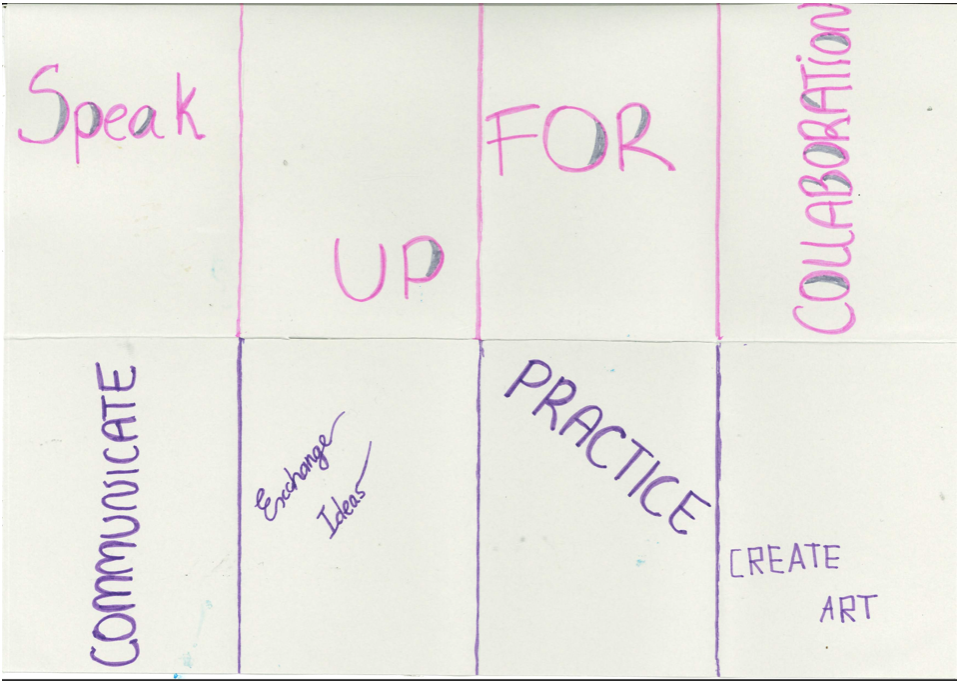
Appendix J: Viktorija’s Zine page.
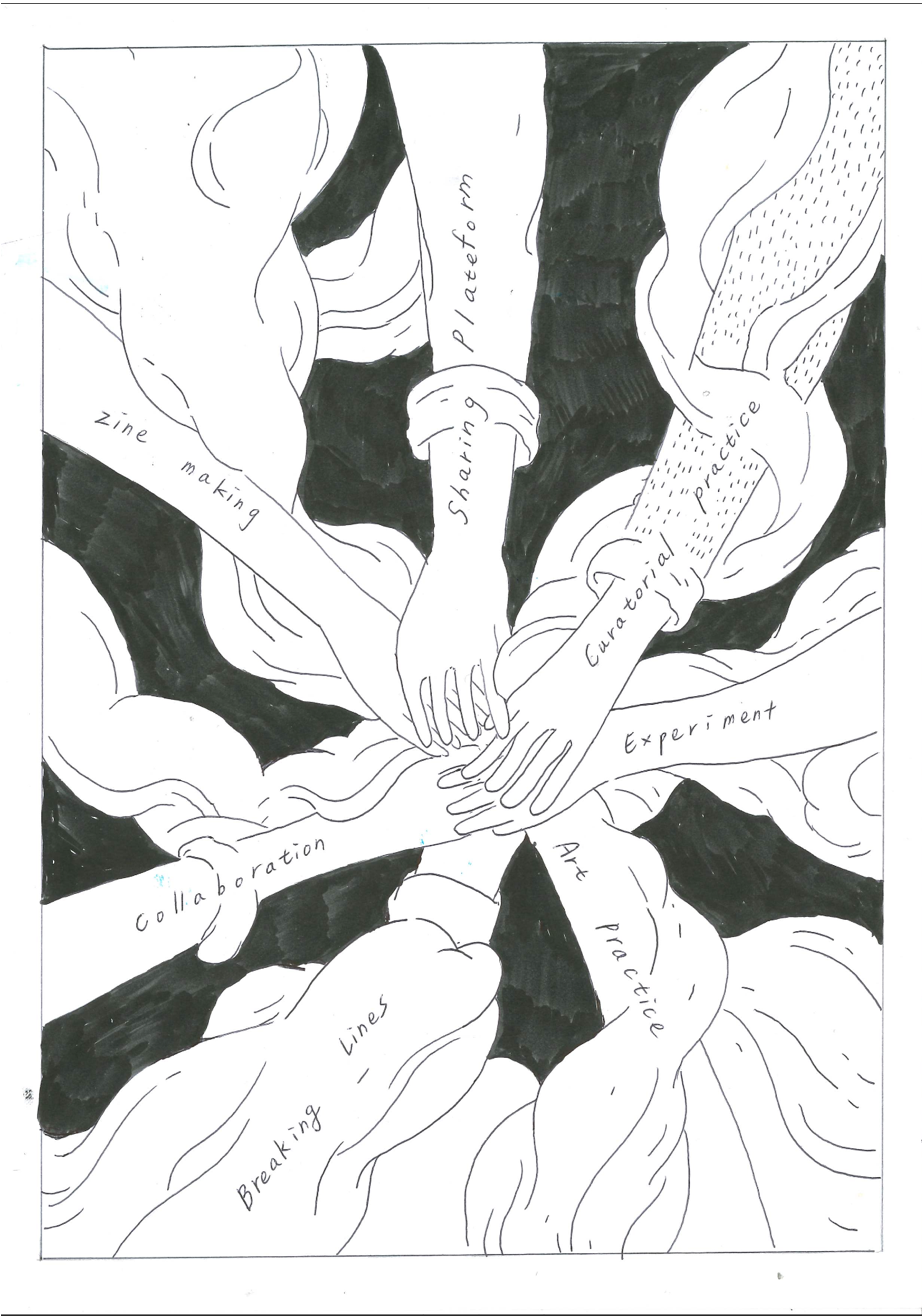
Appendix K: Ya-Hsuan’s Zine page.
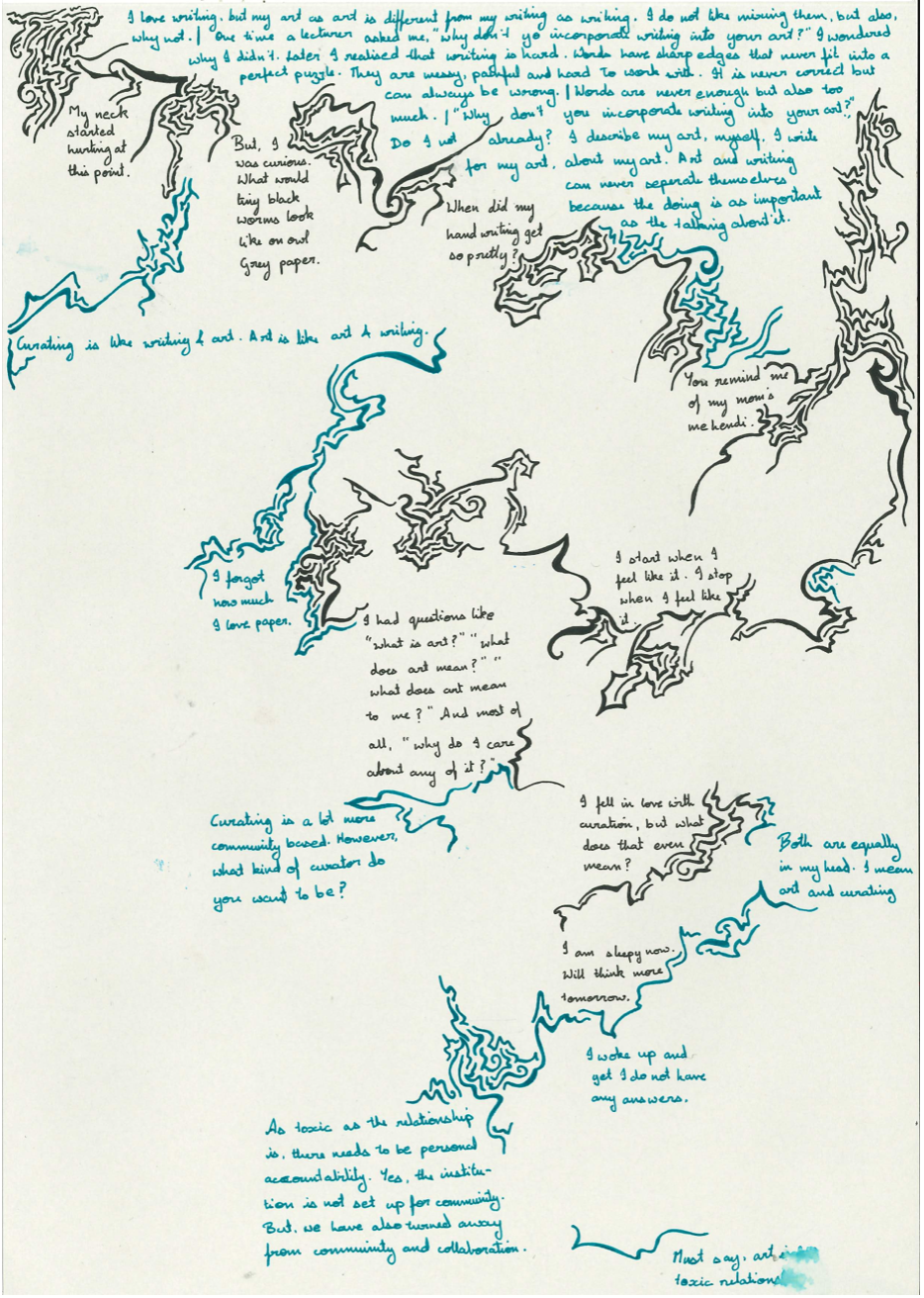
Appendix L: My Zine page.
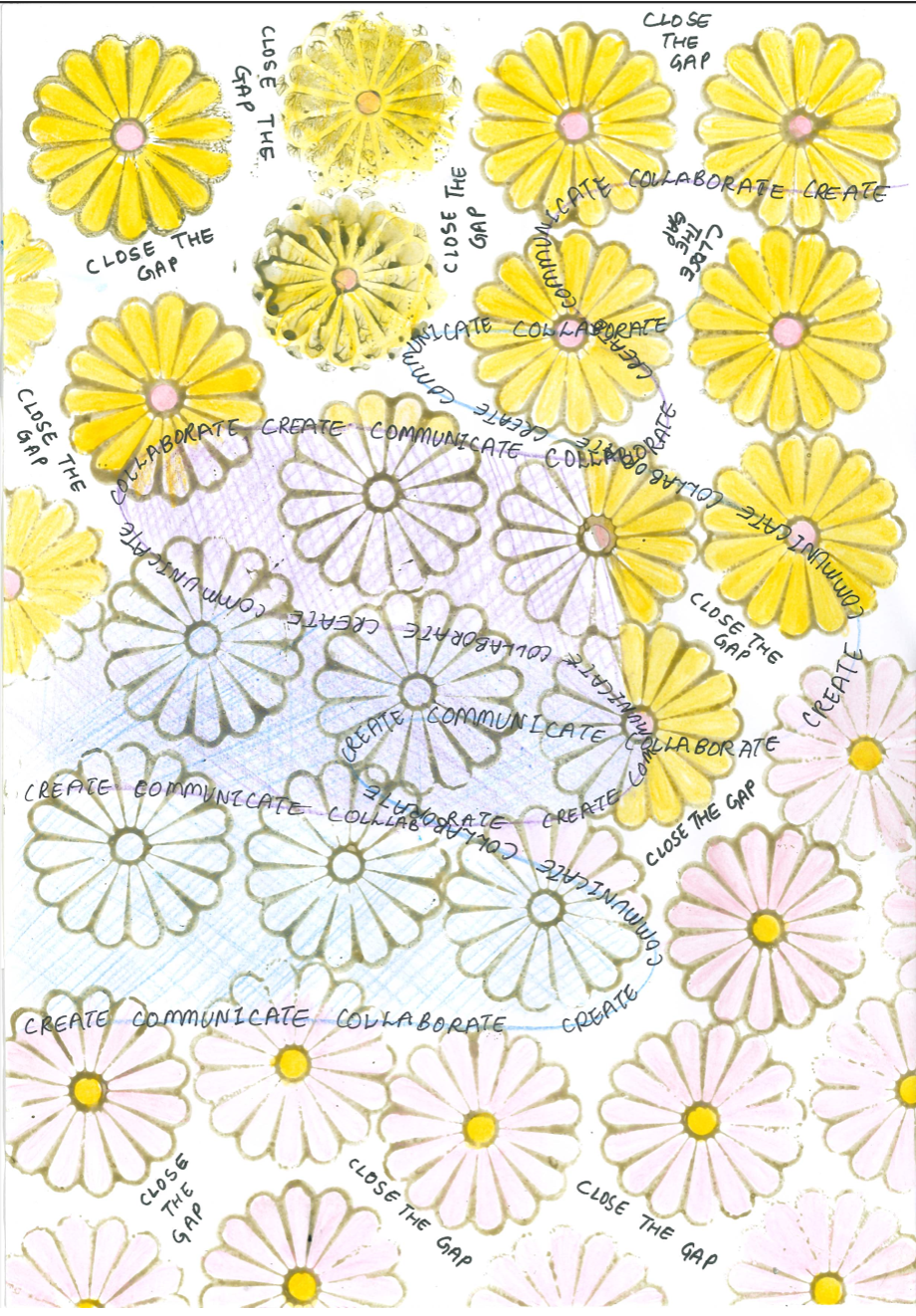
Appendix M: Kushboo’s zine page.
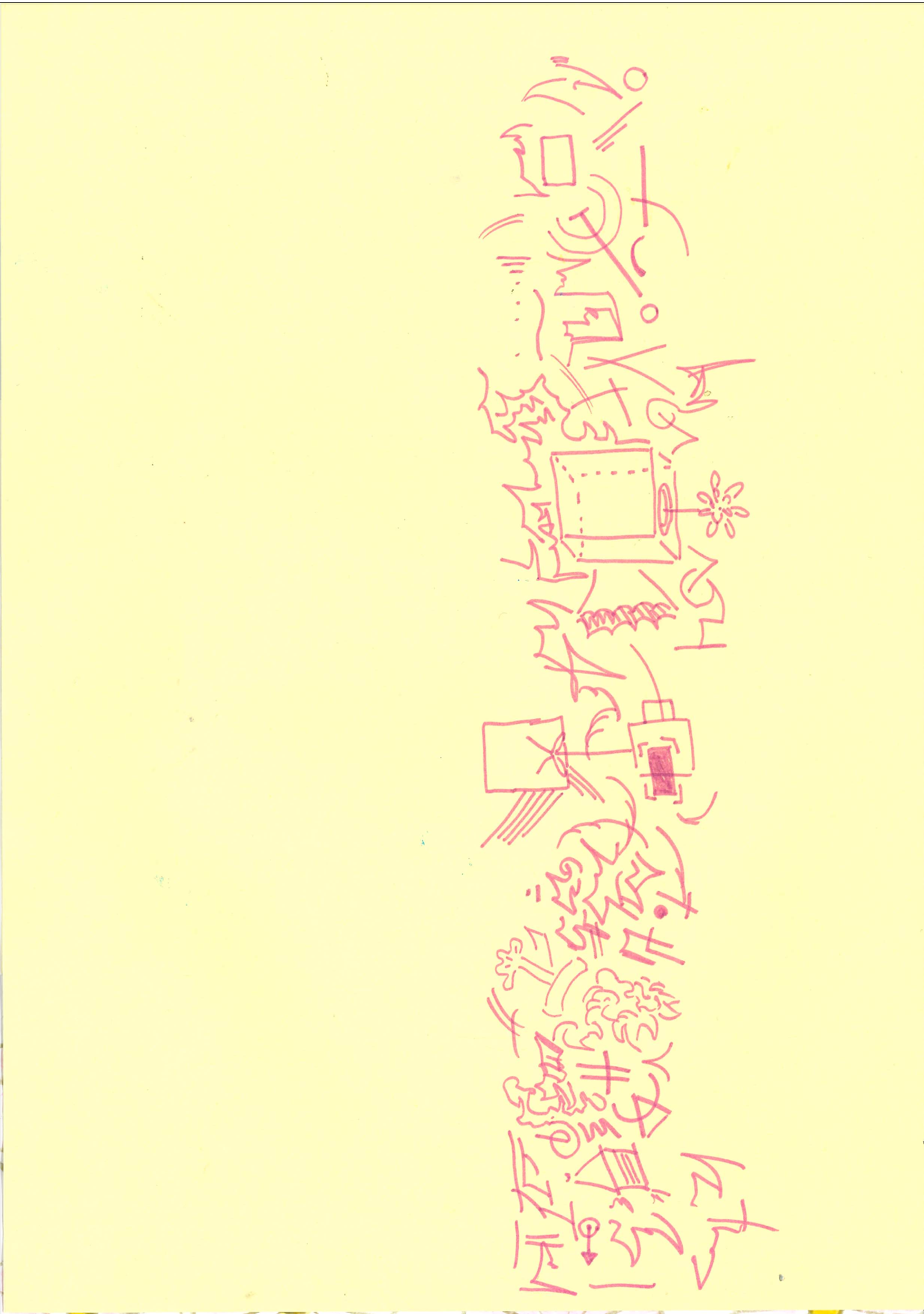
Appendix N: I am not sure whose zine page this is, but it is one of ours.
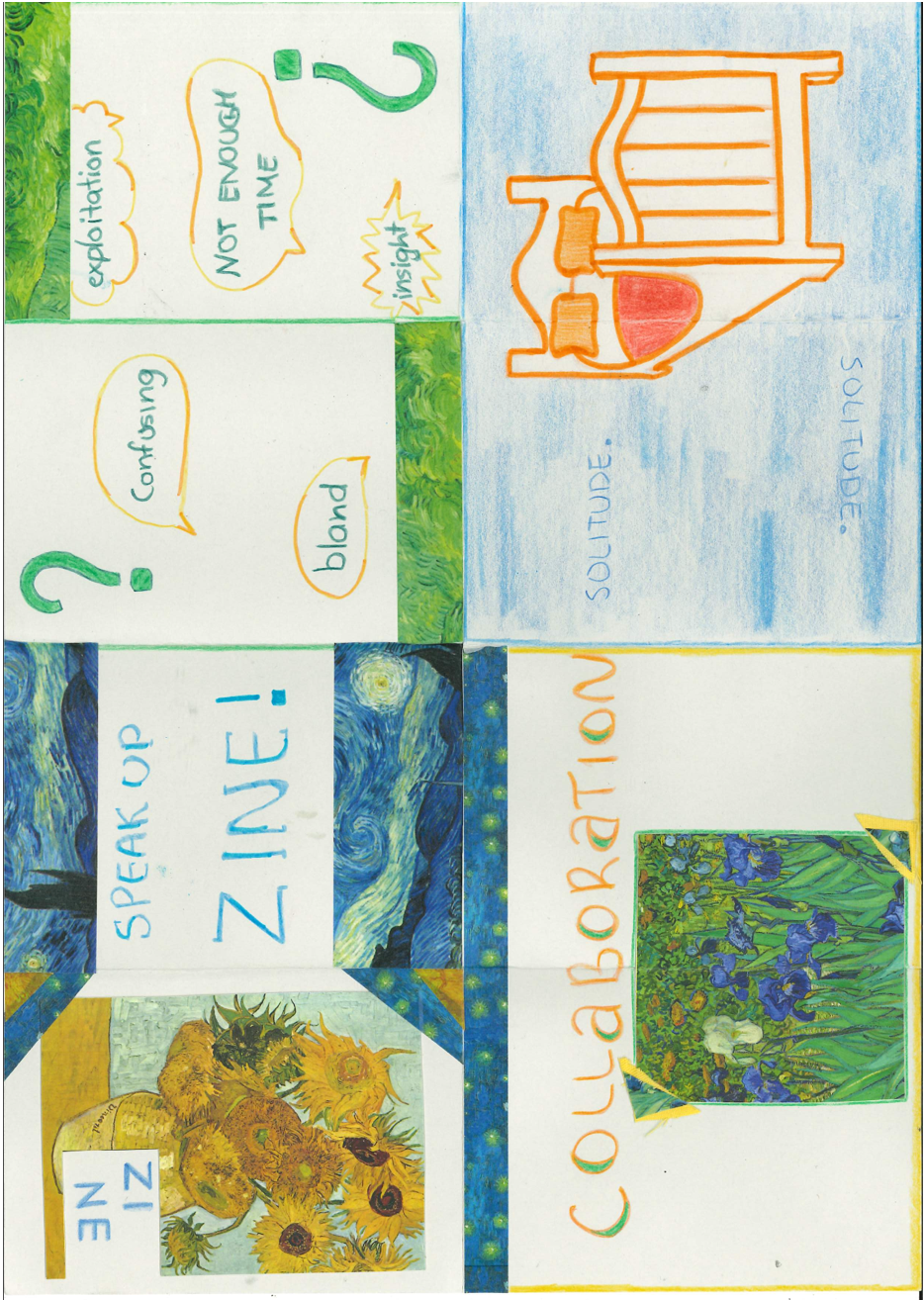
Appendix O: Viktorija’s other Zine page.
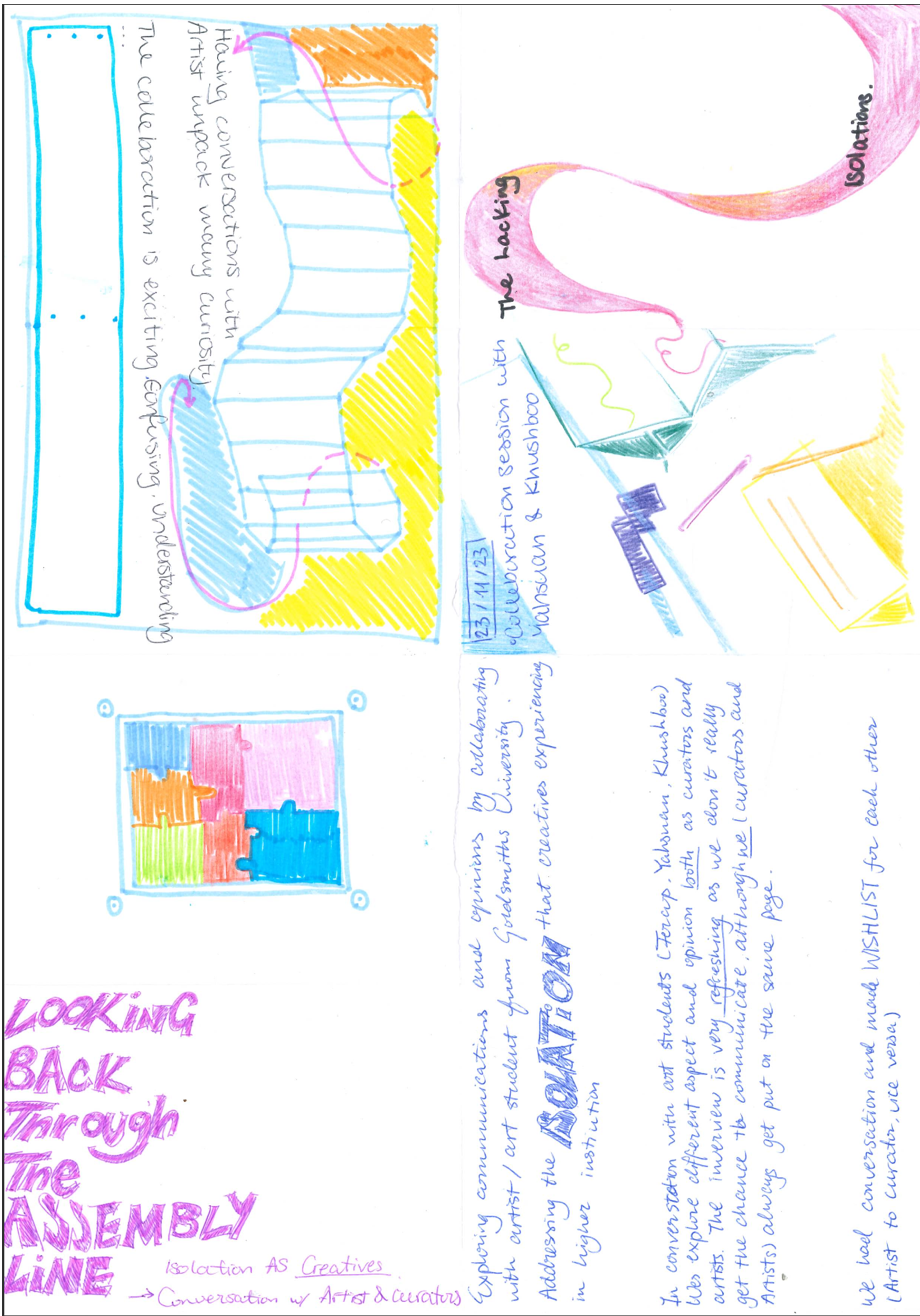
Appendix P: Tiffany’s Zine page.
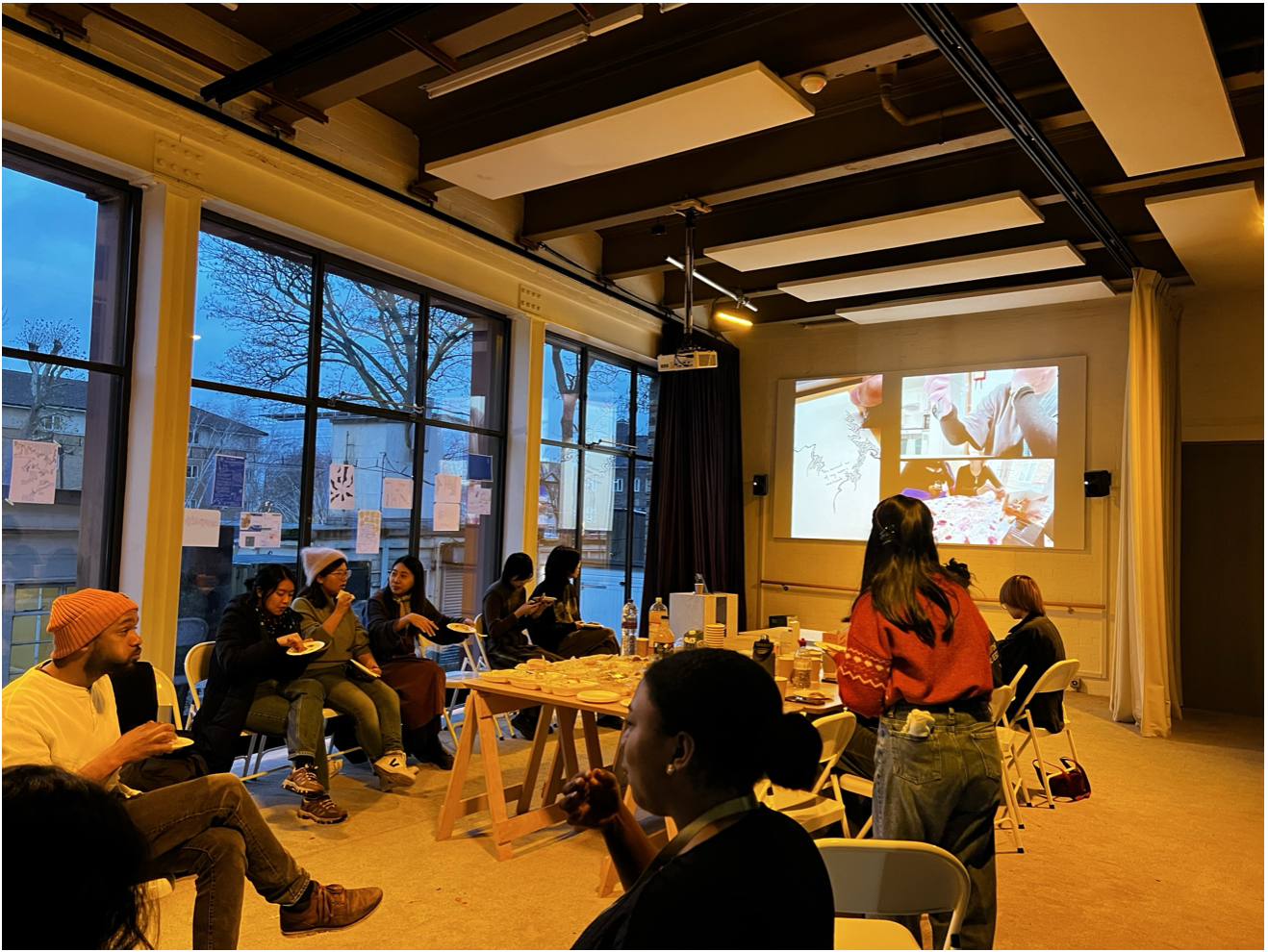
Appendix Q: On the facilitation day. We weren’t able to get any other lighting. It was hard to see, even then, it was a lot of fun.
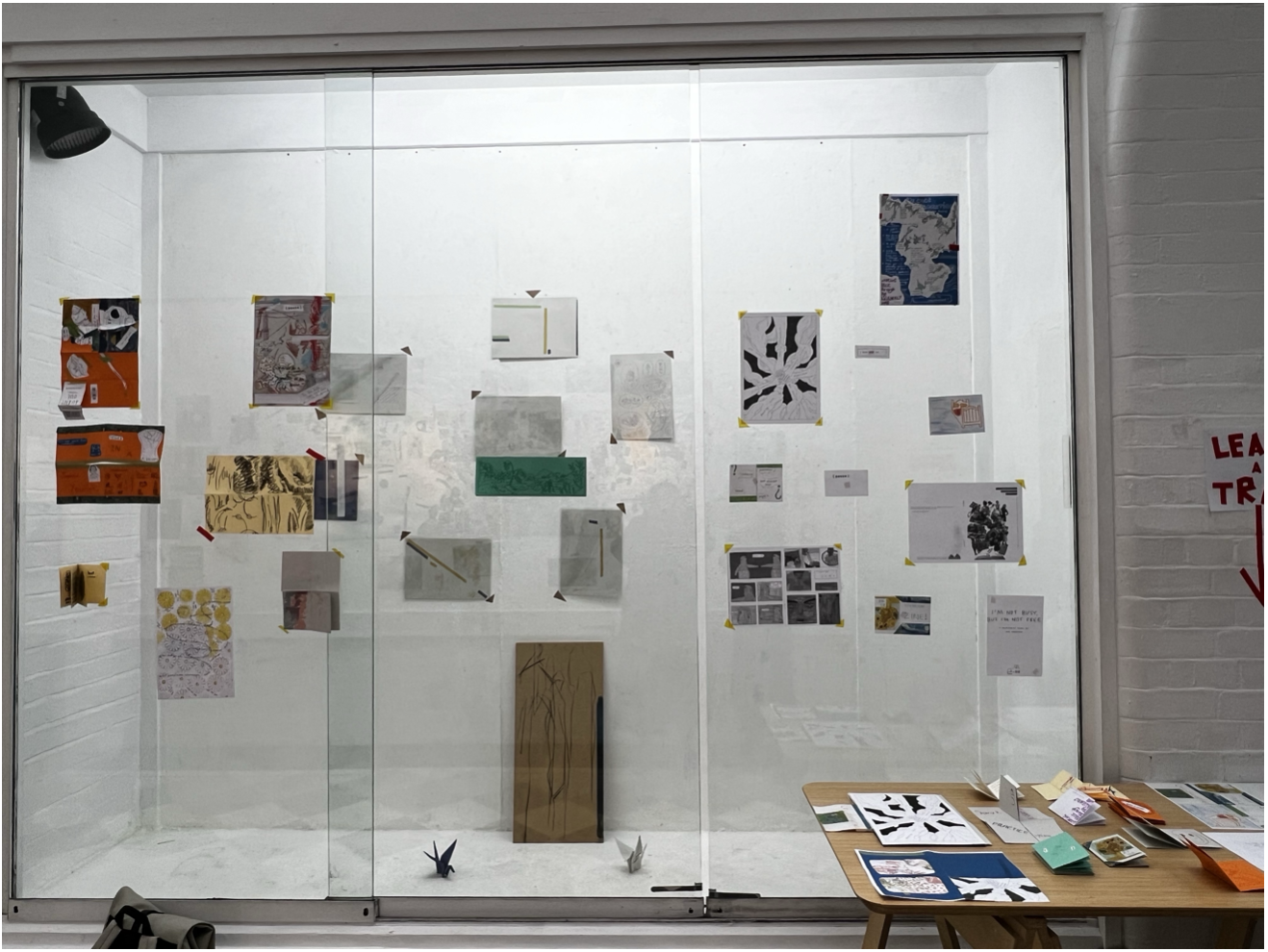
Appendix R: A picture from our section of the exhibition in Week 10.

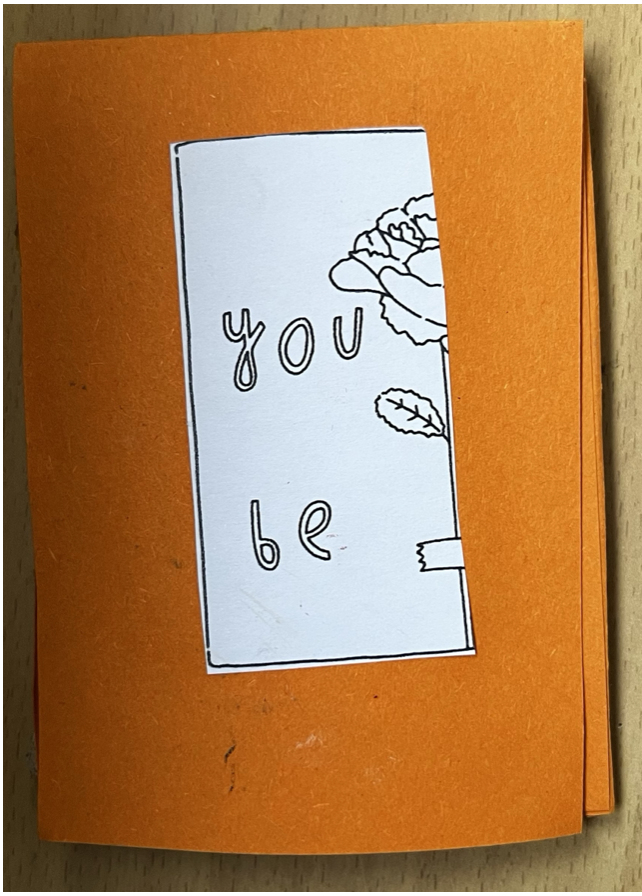
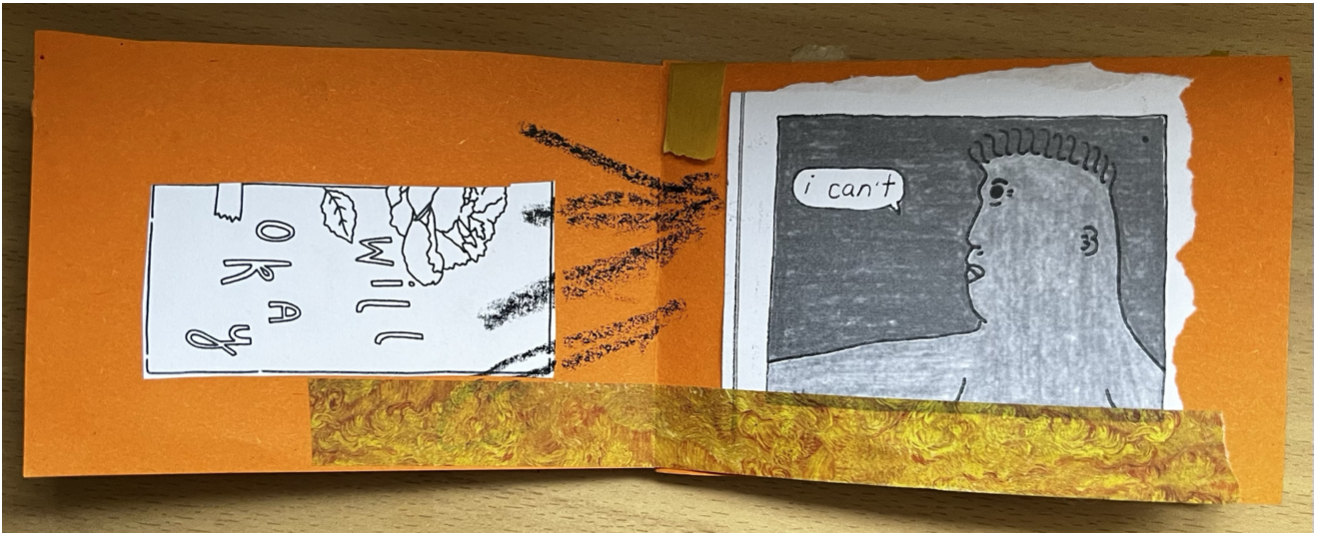


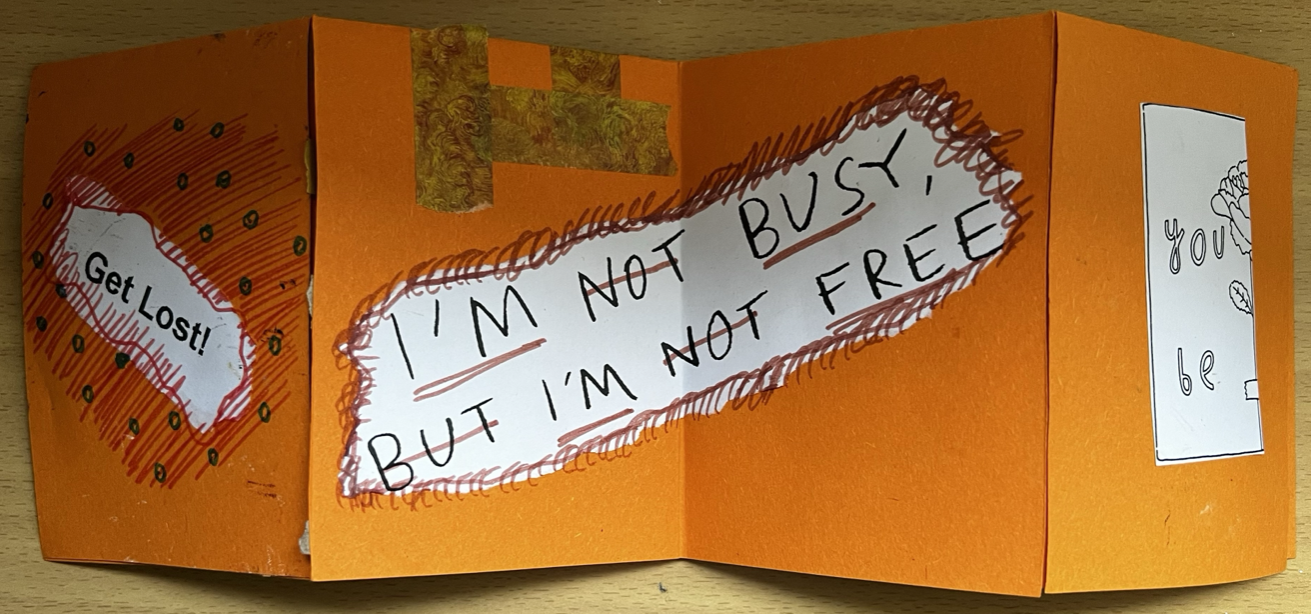
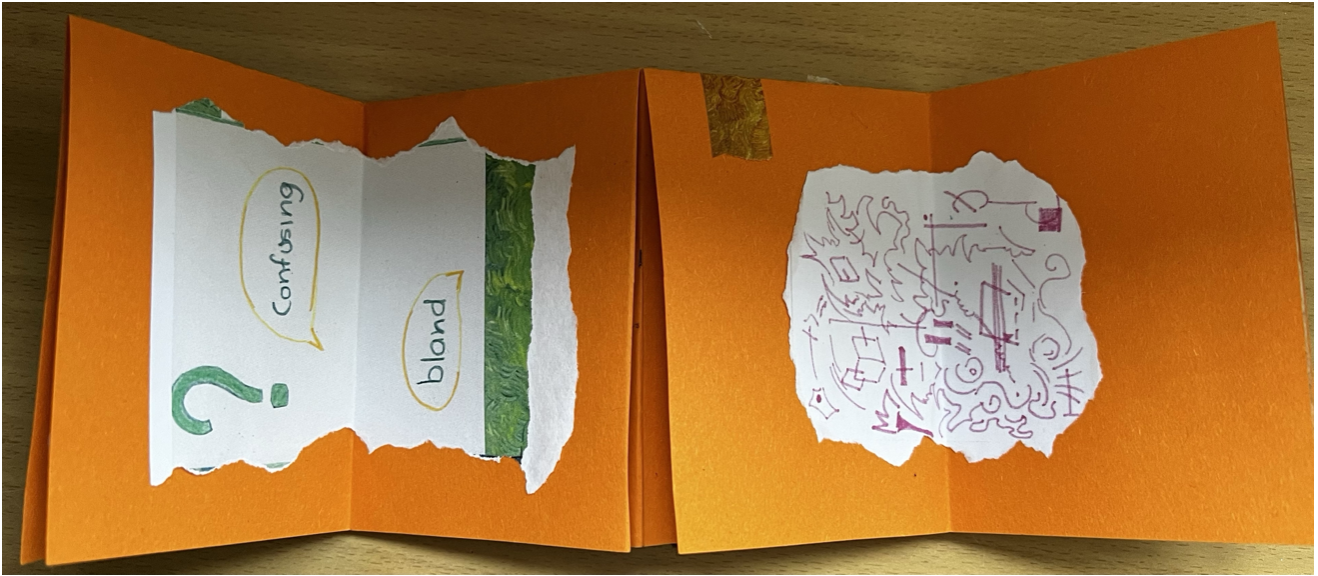

Appendix S: A zine that I absolutely loved by one of the participants.
Grades and Feedback
Grade: 72
Graded on: —
Graded by: Janna Graham
An excellent engagement with discussions of affective labour vis a vis your group process and your emerging praxes as a curator.
You brought in key and diverse literatures.
You documented your process.
You raised very important, and to varying extents unresolvable questions and tensions in curatorial work, analysing and theorising some of its key contractions.
It would have benefited from a little more focus and structure to the argument perhaps by hinging the piece more thoroughly to one of the texts introducing ideas and dynamics of affective labour orienting the other sections - like the zine around this central reading. Might also have been a bit less workload!)
Otherwise, well done.
My Reflections
Yaiza, my personal tutor for years 1 and 2, once told me that some essays are purely written and submitted to obtain a good enough grade to earn one’s degree. While the practical statement initially offended me, I have come to appreciate the merit in such practical advice and thinking.
This entire semester was incredibly exhausting. I loved it, but I was also thoroughly (mentally and physically) exhausted by it. I fully believed that I wouldn’t be able to submit this report because of burnout. I am sincerely glad that I was able to submit something for review and grading.
While I know how I can improve this report structurally, I don’t care to examine it too deeply.