How do Instagram accounts like @thingsdoctorssay counter epistemic violence in the medical field?
This is the Essay I submitted for the module ‘Counter-Forensics’ in the academic year 2024-2025. Grades, feedback, and my reflections are at the end.
How do online spaces like @thingsdoctorssay[1] and the interactions facilitated by these spaces allow for new forms of meaning-making and meaning-sharing by people who have historically been denied epistemic agency? @Thingsdoctorssay is an Instagram account that anonymously collects and shares personal experiences of ableism, medical gaslighting, and medical malpractice. The creator created this online space for commiseration.[2] However, I want to analyse this page as a potential counter-forensics methodology capable of countering epistemic violence and injustice in the medical field. In addition, I want to look at the method of evidencing this space uses as a valid technique to reclaim agency by patients as people who have historically not been given agency to represent themselves in the medical field.
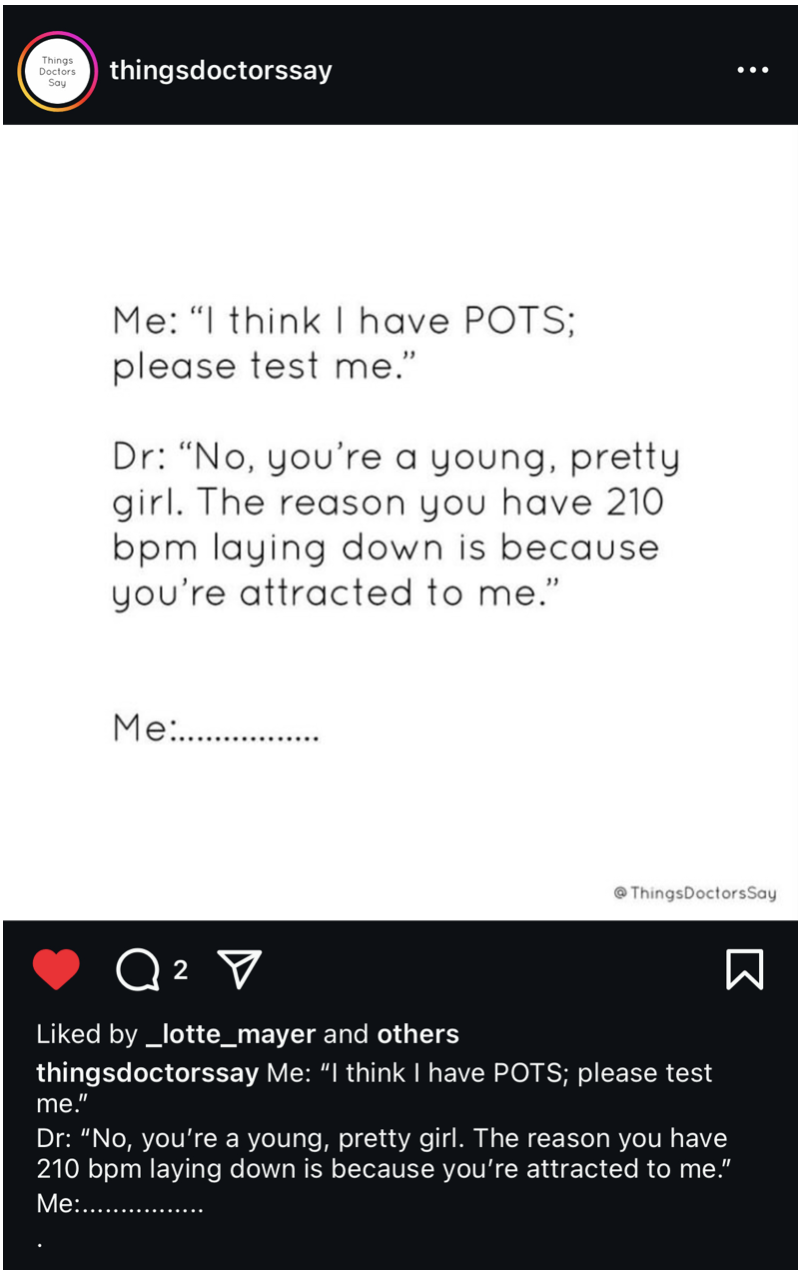
Figure 1. @thingsdoctorssay, Instagram post (2025), Screenshot.
Throughout the module, I have come to understand counter-forensics as a practice of making visible what is not easily detectable due to the embedded nature of our epistemes.[3] It is a practice of detangling hegemonic assumptions about categories like evidence, fact, truth, and reality; a process of trying to understand how these hegemonic assumptions get integrated into the broader socio-cultural paradigm and how to show the violence that this paradigm unintentionally or intentionally perpetuates.[4] In which case, epistemic violence is something counter-forensics can detect and showcase through the mobilisation of varied fieldwork and other ways of evidencing, while maintaining forum, interpreter, and object flexibility.[5]
When I say forum, interpreter, and object flexibility, I mean that there is a versatility in the methods used to make evidence visible, in what can become evidence, where it can be presented, and what kind of profession and person interprets it. This is observed repeatedly on the Forensic Architecture website—how Forensic Architecture investigates their cases and in which forums they present their investigative outcomes. Forensics architecture—a research agency based at Goldsmiths, University of London—aims to “develop, employ, and disseminate new techniques, methods, and concepts for investigating state and corporate violence.”[6] Their team comprises architects, software developers, filmmakers, investigative journalists, scientists, and lawyers. A collective that works across human rights, journalism, architecture, art and aesthetics, academia and the law.[7] The way that Forensic Architecture operates is a perfect example of the porous nature of Counter-forensics as a practice of inverting the forensic gaze and destabilising hegemonic methods of evidencing. Something that @thingsdoctorssay does as well, in an anecdotal, artistic format. But, for me, what brings it out of the anecdotal and into the realm of evidence is the sheer volume of the stories that @thingsdoctorssay has collected over the years; as well as the passionate and consistent endeavour to explore the multi-faceted and often ignored nature of ableism’s penetration into the patient-doctor relationship.
@thingsdoctorssay has shared journal articles, research papers from reputed medical journals, personal stories of medical gaslighting from other Instagram accounts, and so on. However, their posts (their main grid) and stories (the stories instigated by them) are a specific form of storytelling. They centre the patient, their experience, and how the medical field fails them. Their role is to pick at the cog that is epistemic violence faced by patients during one-on-one interactions with doctors in the knowledge production machine. Doctors, in this instance, not only produce knowledge through diagnosis but also maintain the knowledge already produced by deeming who fits the categorisations of the limits set by medical epistemes.
If doctors are just maintaining and furthering the knowledge production methodologies, why is it epistemic violence? It is epistemic violence because doctors and patients have an uneven power dynamic.[8] A doctor's approval not only gives a patient validation but also gives them access to further care. If the doctor is especially perceptive, then the patient has more autonomy. If the doctor doesn’t believe a patient's pain, whether real or unreal, and chooses to use the power they have to deny the person care, then this person may lose much more than just their medical autonomy and agency. This person can lose their right to live a meaningful and fulfilling life due to a lack of appropriate medical care. They might even get entangled in legal battles if the doctor believes that the patient is faking illness(es).[9] On a socio-cultural level, a medical diagnosis is the difference between a person being difficult or ill. Some illnesses are culturally considered more valid than others. This social construction impacts the illnesses that doctors deem important and unimportant. This essay focuses on this power imbalance and the difficulty in penetrating the medical field as a patient with their own story. It is harder to penetrate the medical field’s knowledge production streams as a patient who wants their story to be evidenced in a way where the patient maintains epistemic agency than to be heard in spaces like @thingsdoctorssay because of this power imbalance. @Thingsdoctorssay is a counter-space, a counter-forum.
While @thingsdoctorssay has collected much evidence over the years, this essay wants to analyse the platform along two praxes: sexism in the medical field and how this impacts doctor-patient interactions and the impact on patients when doctors lack knowledge of certain illnesses. This is done while considering the forum (Instagram), interpreter (@thingsdoctorssay) and object (the testimonials).
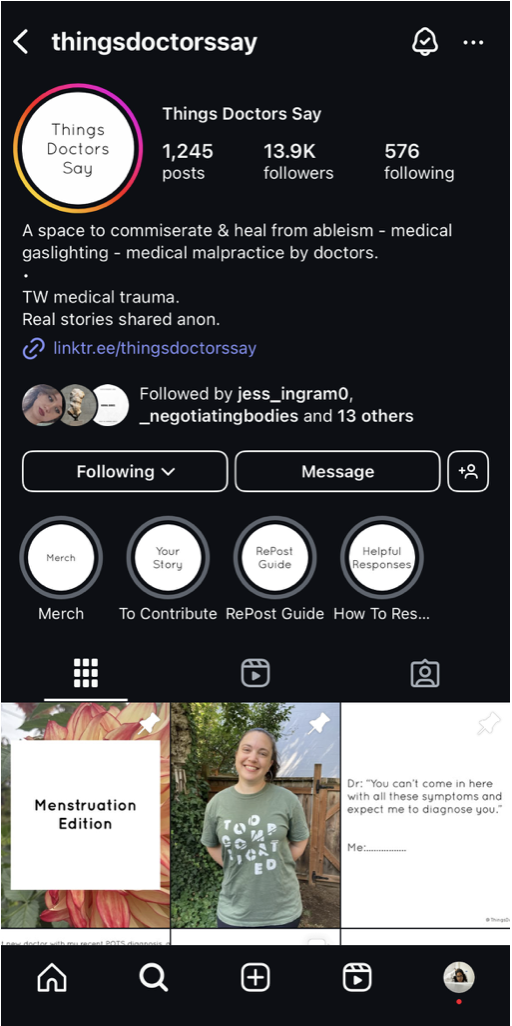
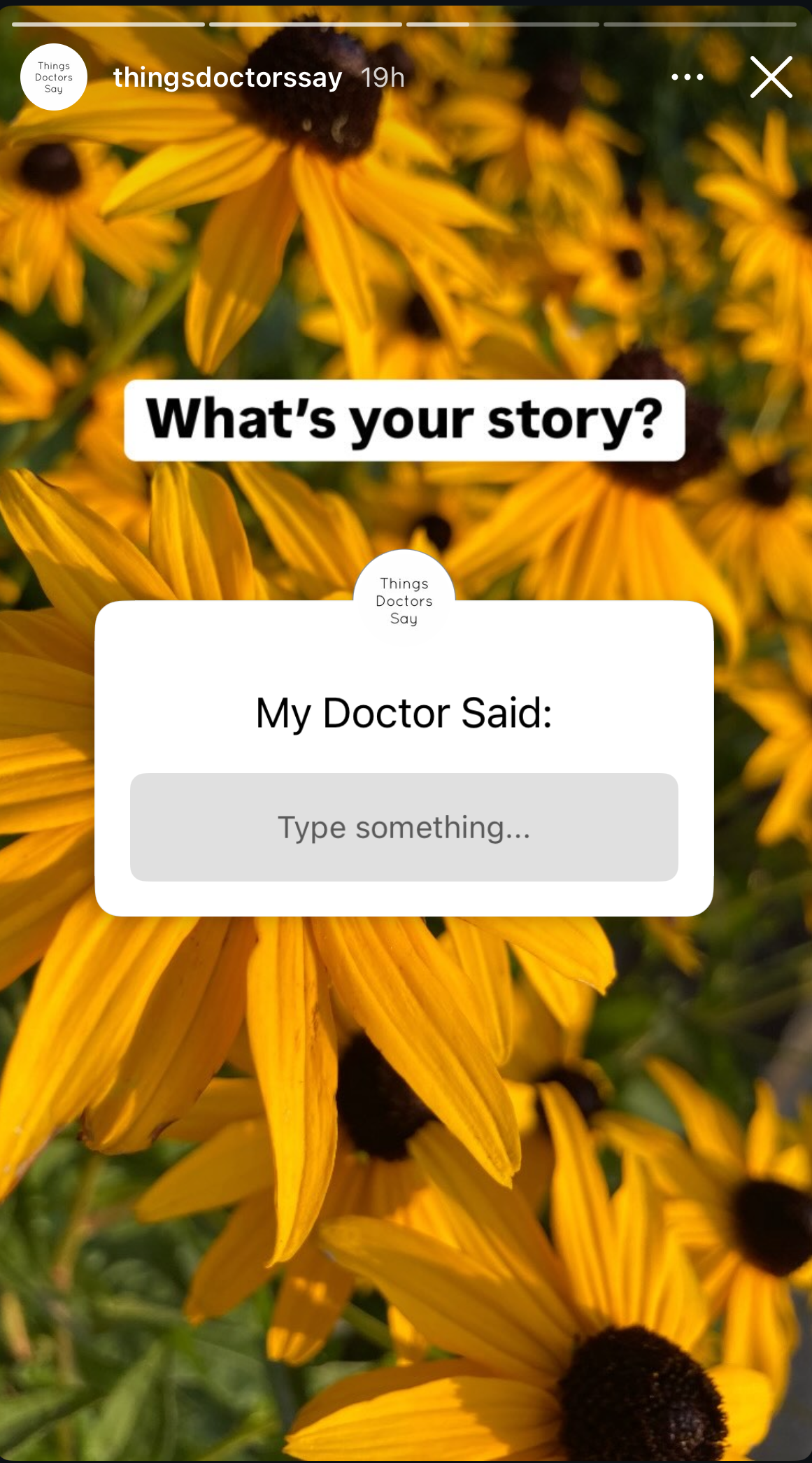
Figure 2. @thingsdoctorssay, Instagram account (2025), Screenshot.
Figure 3. @thingsdoctorssay, Instagram story (2025), Screenshot.
First, to observe the effect of sexism in the medical field, it is necessary to track the history of the womb in medicine. Hysteria was first used as a formal diagnosis by Hippocrates, the father of medicine. Hysteria comes from the Greek word hustera, which translates to womb. It was believed that Hysteria was caused by a wandering uterus, in due course strangling the women, leading to disease. This happened if she was not pregnant. There were no defined symptoms, thus leading to hysteria being used to explain away any demonstration of emotional volatility, difference/abnormality, and/or “strange behaviour.”[10] An example of this would be Hippocrates himself—his description of hysteria could be attributed to epilepsy.[11] This disease has a history of over 4000 years, with it being considered an invalid diagnosis as a disorder through its deletion in the 1980 DSM-III.[12] It was deemed that hysteria affected women because supernatural forces easily influenced them, or they were guilty for not having children or for sinning. The treatments ranged from herbs, sexual abstinence or sex, exorcisms, lobotomies, clitoridectomies, forced bedrest,[13] or later during the time period of the witch trials, fire as punishment or proof of the woman not being a witch.[14] It was considered a woman’s disease till well into the 19th century. With Sigmund Freud, it was believed that the lack of conception was the result, not the cause, of hysteria. [15]
In current times, the attritional violence of situating women’s primary role as child bearers is that they were excluded from medical trials, especially women of childbearing age.[16] This has led to a gender gap in medical research. Every volatility, difference/abnormality, and/or “strange behaviour” being attributed to hysteria (relating to the womb) has led to women’s pain being ignored/dismissed, or chalked up as anxiety. This is done through attributing symptoms to menstruation or what is believed to be women’s tendency to overreact/over exaggerate.[17] Elizabeth Comen[18] says that, “there’s a long-standing idea that because we endure childbirth we’re meant to endure pain.” This shows up as doctors not giving women painkillers/relievers for IUD insertions or endometrial biopsies.[19] Or women’s menstrual pain being dismissed as them being a problem instead of them having an issue that needs to be medically addressed.[20]
Science holds the veneer of impartiality. It is impartial because it is cold, hard facts based on data. However, the data can be flawed if the people from whom this data is collected are a particular group, which is then falsely applied universally. A simple example of this is the presentation of heart attacks (acute myocardial infarction). For a very long time, heart attacks were only researched in men, and the findings were applied universally. Heart attacks present differently in men and women. The tests used to detect heart attacks don’t work accurately on women either. Because of this research gap and lack of proper equipment, it takes longer to suspect and then detect this in women, leading to more severe complications.[21]
All of this official knowledge production to remedy epistemic injustice and violence doesn’t happen unless intersectional and critical epistemologies are cultivated.[22] Anecdotal evidence is necessary because a diagnosis is anecdotal till it is eventually attached to an organ system. Sara Ahmed,[23] in her blog post titled Evidence says that “the evidence we have of racism and sexism is deemed insufficient because of racism and sexism.” Even the insinuation that @thingsdoctorssay’s now 1243 posts as simply and only anecdotal when there is 1243 bits of evidence that there is sexism, racism, ageism, fatphobia, and ableism in the medical field is in itself sexist, racist, ageist, fatphobic and ableist. This is because sexism, racism, ageism, fatphobia, and ableism in the medical field as possible experiences for patients is hard to believe for two reasons—trust in the institution[24] and an incapacity to comprehend an occurrence outside one’s own experience,[25] on both the part of the educated individual (the doctor), and the general public.
Institutional betrayal[26] occurs when we rely on the system to operate in our best interests.[27] The medical system is based on this reliance. The medical model posits that the body has something wrong with it that is inherently pathological. This thing that needs to be fixed within the body can be plainly found through their tests and fixed by doctors[28] who have the qualifications to do so through their specific specialisations, which have been validated by university degrees and governmental institutions through medical licenses. At that moment, a doctor is the human embodiment of an epistemic foundational belief. A belief that the doctor, once they learn everything in their books and have shadowed other, older, better knowing doctors, now knows everything. A patient is an object to fix, not someone to become curious about, especially not someone to become curious about with the patient having an active part in this curiosity. I say this because of how gatekept medical knowledge is. If a patient appears knowledgeable about their condition/illness, doctors often find that suspicious, maybe even a marker of the patient lying or overreacting about their condition/illness. This further cements the power imbalance between the doctor and the patient.
While this imbalance of power as a generational legacy can be shifted through new ethical practices, such as more equitable research methods that consider race, gender, sex, and other human attributes directly impacting effective treatment differences—destabilising the androcentricity in medicine.[29] Alternatively, methods of shared decision-making can be employed where the crux of the patient and doctor relationship is based on the belief that the doctor doesn’t know everything and the patient’s bodily experience is valued, with both of them together trying to find the best treatment options.[30] This doesn’t mean that the hidden curriculum[31] passed down from the older doctors to the younger doctors can be ignored. The doctor was always believed to and institutionally stamped as knowing more than the patient, even better than the patient, about the patient’s own bodily experience. This can manifest by ignoring the patient’s words about their pain. What was then “hysteria” now becomes “difficult”, exaggeration of pain,[32] drug seeking, or just plain lying.[33] If the doctor believes that one is “difficult”, exaggerating their pain, drug seeking, or just plain lying, it can feel like it's not just this one person but the very institution saying that.
Doctors may be more likely to perpetuate the “hysteria” diagnosis in modern, colloquial, and subtle ways by internalising behaviours deemed acceptable through the actions of their seniors.[34] They might even feel justified in the epistemic injustice they perpetuate because they are backed by “data." Elizabeth Comen, an oncologist specialising in breast cancer and the author of All in Her Head: The Truth and Lies Early Medicine Taught Us about Women’s Bodies and Why It Matters Today, discusses how the medical field and the knowledge produced within it have an indoctrinating capacity. Even she, who researches sexism in the medical field and its effects today, falls into the habit of minimising people’s pain.[35] The act of not listening to the patient, or centring the patient’s bodily experience, is a habit cultivated in the medical field through paternalistic practices embedded in the profession.[36] Comen believes it is human nature to blame the person presenting with different symptoms. It is challenging and requires great humility to approach with curiosity rather than the arrogance instilled by the institution.[37]
While this unpacking, unlearning, and retraining happens, where do patients go to centre their stories? What forums can they use where their epistemic agency is restored rather than analysed, as in the papers that I have read in the medical forums? And how do patients cultivate the skill to detect these discriminations in the medical profession, instead of the institutional trust that is socio-culturally embedded in us?
The forum, interpreter, and object dynamic that has persisted as an enduring legacy in the medical field needs fundamental change. The interpreter has always been the doctor, the patient is viewed as the object to be analysed and fixed, and where the doctor maintains their power, it becomes the forum. @thingsdoctorssay destabilises this on multiple levels. Using a public account on a social media platform like Instagram doesn’t have the same barricaded effect as the medical institution. An Instagram account is more approachable and accessible than journals, books, and the people who write them. The account is made more approachable by how @thingsdoctorssay behaves, which is in a friendly demeanour, trying to centre stories that are not only submitted to them but also from other Instagram accounts, and where they fail during one-on-one interactions, they post about why they have.
The interpreter, unlike in the medical field, is a patient who herself shares her plight with medical gaslighting, malpractice, and ableism. She has set up the account in such a way as to safeguard the people being spoken about. The anonymisation is helpful as the patients do not become pariahs, leading doctors or the general public to further mistreat them. The anonymisation of the person who runs the account is necessary as she requires treatment from the same system that has often taken away her epistemic agency. More than that, testimonials of medical trauma are more easily ignored because of the power imbalance between the expert and the object over which they have expertise, the illusion of the factualness of “data”, and the social construction of the patients who are victims as “hysterical.” While the anonymisation of @thingsdoctorssay’s content does make the evidence suspect, it is harder to ignore it because of the volume of the content and how varied the evidence is. Because of the sheer volume of the content, I would argue that anonymising both doctors and patients indicates a larger systemic problem rather than a pointed attack on anyone. What @thingsdoctorssay is doing is establishing a counter forum because the forum of the medical field isn’t penetrable for patients as epistemic agents, allowing people who have historically been denied epistemic agency to have epistemic agency (de-objectifying the body and mind of the patient), and showing the flaws in the system when the doctor is always the interpreter in the forum.
This space that @thingsdoctorssay has cultivated shows the faults in the hegemony of the medical field and the methodologies it uses to produce knowledge. However, its true merit is in the commiseration aspect. Medical encounters have the capacity to cause PTSD (Post Traumatic Stress Disorder) as studied in this paper: “Clinician-associated traumatization from difficult medical encounters: Results from a qualitative interview study on the Ehlers-Danlos Syndromes.”[38] The trauma, according to the paper, led to some patients refusing to go back to doctors or fear trying to approach doctors beyond their circle of vetted doctors. But this refusal of acknowledgement from doctors makes it hard for people in pain to be acknowledged by the society around them because of institutional trust by people who have not experienced institutional betrayal—this is seen very clearly through sexism in the medical field. Where do people like this go to seek compassion? They go to people who understand, for whom the experience of medical gaslighting, malpractice, and ableism is not beyond their scope of experience. This is not just for solidarity and support, but also to learn how to detect the epistemic violence and injustice they are facing and get care out of a broken system. In which case, @thingsdoctorssay doesn’t need to hold up to the exacting standards of legally defined evidence; its role is to clearly showcase the cog that is epistemic violence faced by patients in the machine that is the medical institution.
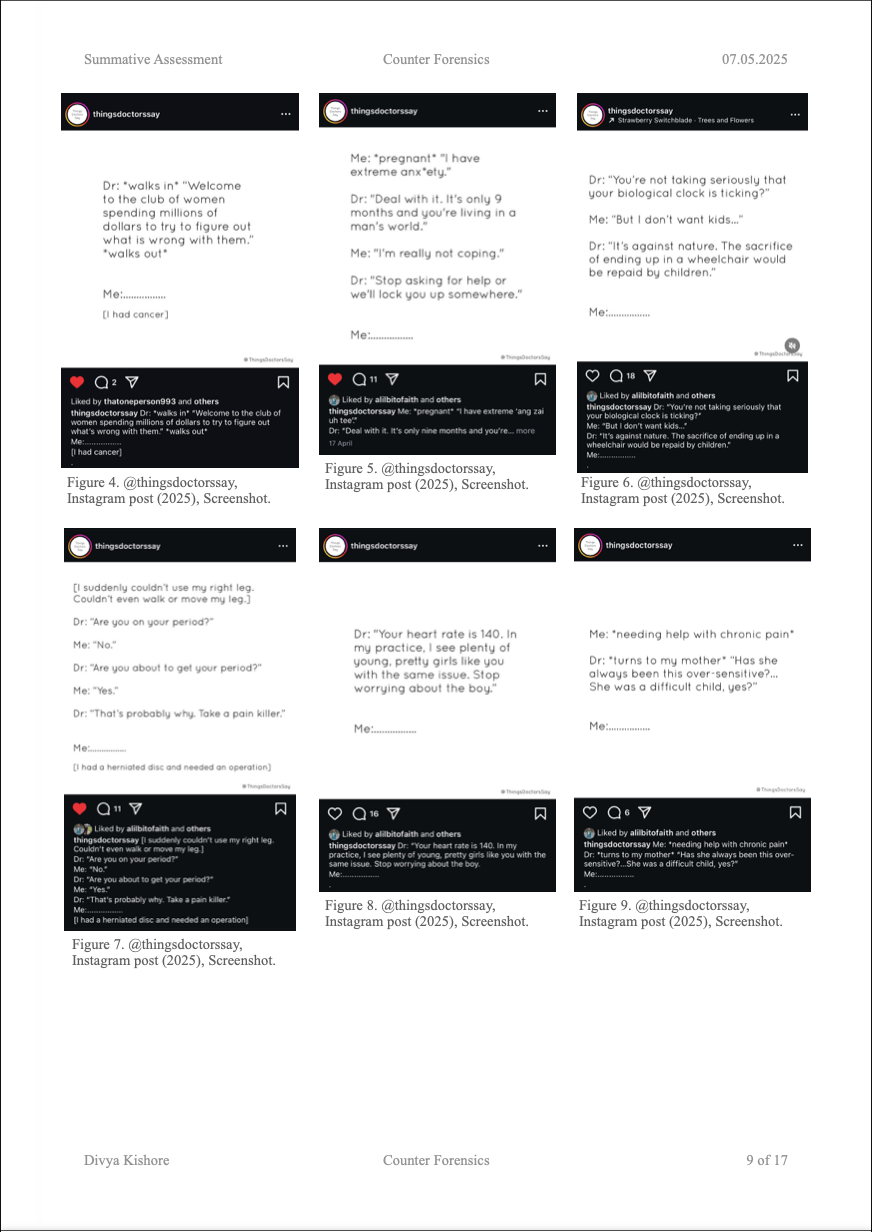
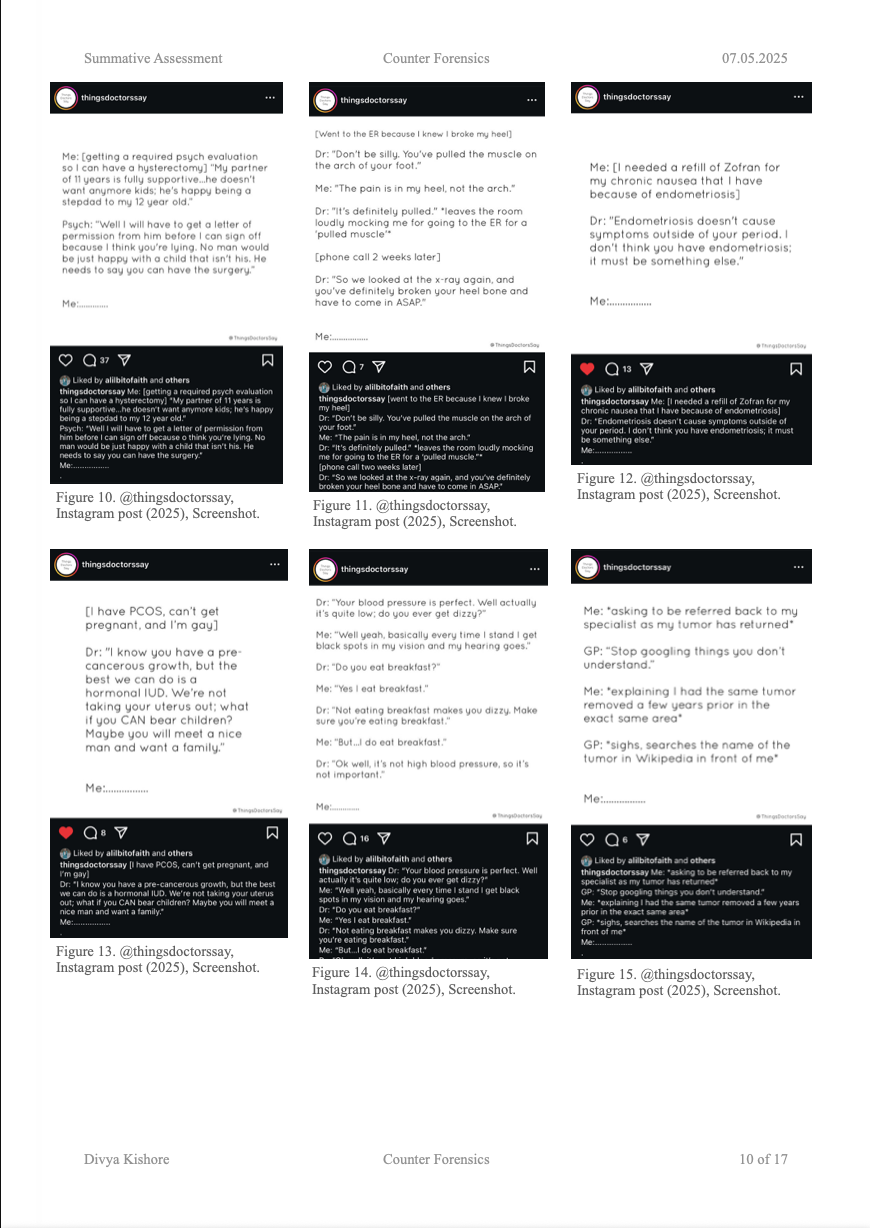
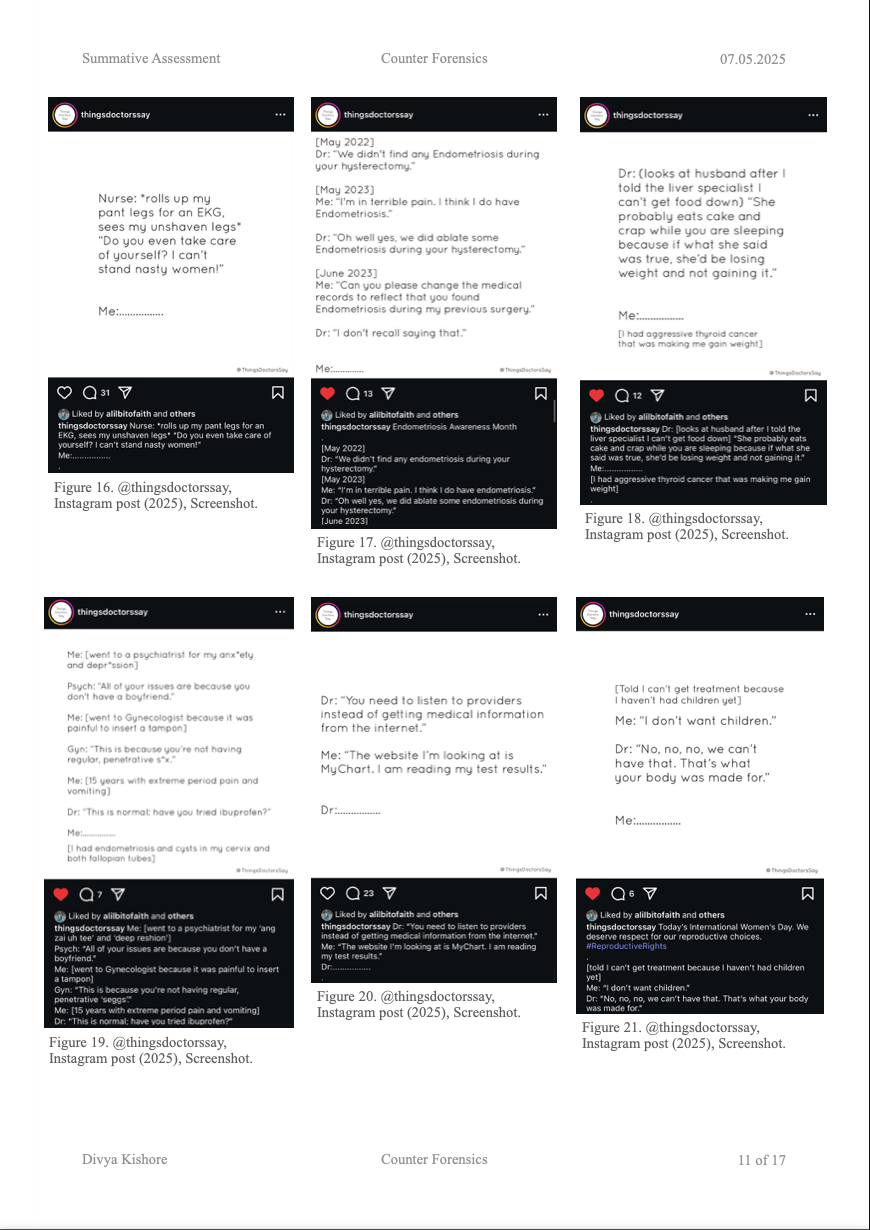
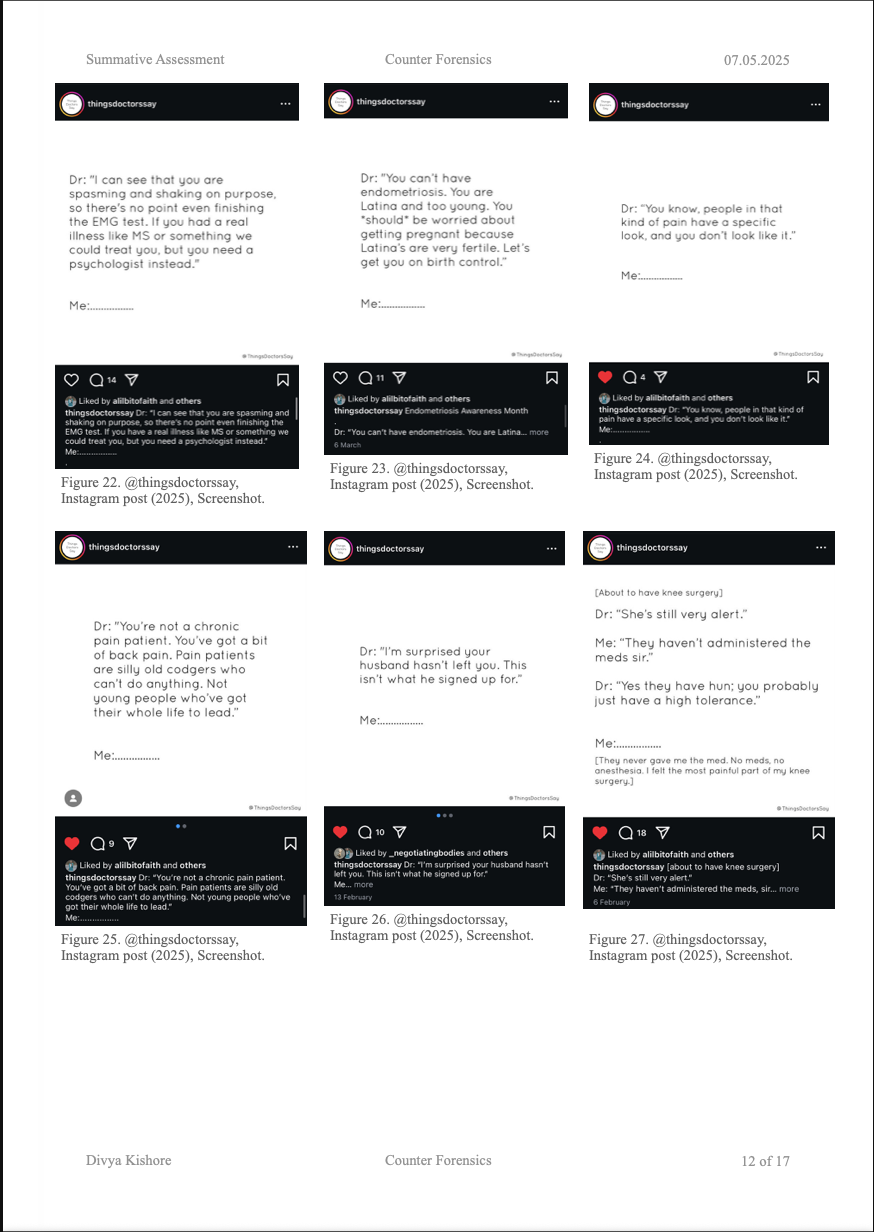
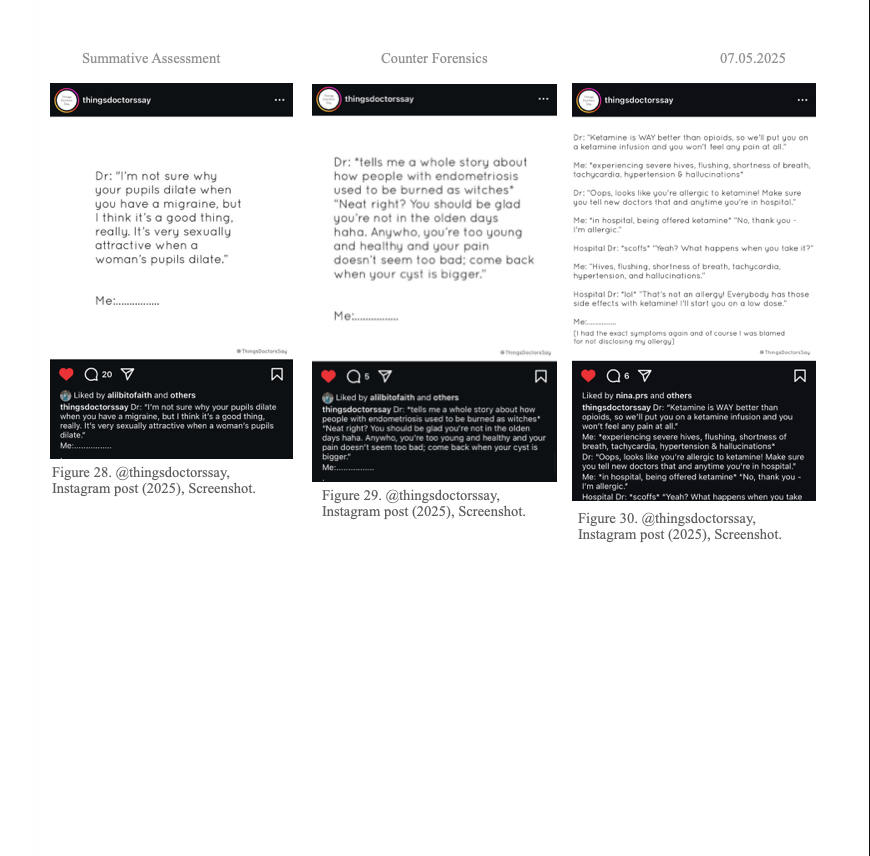
This essay has mainly traced epistemic violence in the medical field by looking at history and how it manifests in today’s world. However, what my essay has not and cannot do is showcase what it means to be the patient at the receiving end of this epistemic injustice. @Thingsdoctorssay captures this affect; to demonstrate this, I wish to end this essay with 27 of their most recent posts.
Footnotes
[1] Anonymous, “thingsdoctorssay,” Instagram account, March 24, 2021, https://www.instagram.com/thingsdoctorssay?igsh=MWx3YWd3a2tjNjBibw==.
[2] Anonymous, “thingsdoctorssay.”
[3] Basak Ertur, “Week 4: Secrets Traces” (Lecture to Counter Forensics class, Goldsmiths, University of London, February 3, 2025).
[4] Basak Ertur, “Week 1: Forensis” (Lecture to Counter Forensics class, Goldsmiths, University of London, January 13, 2025).
[5] Basak Ertur, “Week 3: Seeing Violence.” (Lecture to Counter Forensics class, Goldsmiths, University of London, January 27, 2025).
[6] “About,” Forensics Architecture, Accessed March 5, 2025, https://forensic-architecture.org/about/agency.
[7] “About,” Forensics Architecture.
[8] Ally Greenhalgh, “Medicine and Misogyny: The Misdiagnosis of Women,” Confluence (blog), NYU Gallatin, December 6, 2022, https://confluence.gallatin.nyu.edu/sections/research/medicine-and-misogyny-the-misdiagnosis-of-women#easy-footnote-18-22748.
[9] Colin M.E. Halverson, Heather L. Penwell, and Clair A. Francomano, “Clinician-Associated Traumatization from Difficult Medical Encounters: Results from a Qualitative Interview Study on the Ehlers-Danlos Syndromes,” SSM - Qualitative Research in Health 3 (June 2023): 100237, https://doi.org/10.1016/j.ssmqr.2023.100237.
[10] Greenhalgh, “Medicine and Misogyny: The Misdiagnosis of Women.”
[11] Cecilia Tasca, Mariangela Rapetti, Mauro Giovanni Carta, and Bianca Fadda, “Women and Hysteria in the History of Mental Health,” Clinical Practice & Epidemiology in Mental Health 8, no. 1 (October 19, 2012): 110–19, https://doi.org/10.2174/1745017901208010110.
[12] Tasca, Rapetti, Carta, and Fadda, “Women and Hysteria in the History of Mental Health.”
[13] Lea Merone, Komla Tsey, Darren Russell, and Cate Nagle, “Sex Inequalities in Medical Research: A Systematic Scoping Review of the Literature,” Women’s Health Reports 3, no. 1 (March 1, 2022): 344–344, https://doi.org/10.1089/whr.2021.0083.correx.
[14] Tasca, Rapetti, Carta, and Fadda, “Women and Hysteria in the History of Mental Health.”
[15] Tasca, Rapetti, Carta, and Fadda, “Women and Hysteria in the History of Mental Health.”
[16] Suzanne Koven, “How Gender Bias in Medicine Has Shaped Women’s Health,” Harvard Medicine Magazine, October 2025, https://magazine.hms.harvard.edu/articles/how-gender-bias-medicine-has-shaped-womens-health.
[17] Heather C. Guidone, “The Womb Wanders Not: Enhancing Endometriosis Education in a Culture of Menstrual Misinformation,” in The Palgrave Handbook of Critical Menstruation Studies, ed by Chris Bobe, Inga T. Winkler, Breanne Fahs, Katie Ann Hasson, Elizabeth Arveda Kissling, and Tomi-Ann Roberts, Singapore: Palgrave Macmillan, 2020; online ed., 2020, https://www.ncbi.nlm.nih.gov/books/NBK565622/.
[18] Koven, “How Gender Bias in Medicine Has Shaped Women’s Health.”
[19] Koven, “How Gender Bias in Medicine Has Shaped Women’s Health.”
[20] Guidone, “The Womb Wanders Not: Enhancing Endometriosis Education in a Culture of Menstrual Misinformation.”
[21] Merone, Tsey, Russell, and Nagle, “Sex Inequalities in Medical Research: A Systematic Scoping Review of the Literature.”
[22] Moira Pérez, “Epistemic Violence: Reflections between the Invisible and the Ignorable,” El lugar sin límites 1, no. 1 (2019): 81–98.
[23] Sara Ahmed, “Evidence,” Feministkilljoys (blog), July 12, 2016, https://feministkilljoys.com/2016/07/12/evidence/.
[24] Carly Parnitzke Smith, and Jennifer J. Freyd, “Dangerous Safe Havens: Institutional Betrayal Exacerbates Sexual Trauma,” Journal of Traumatic Stress 26, no. 1 (February 2013): 119–24, https://doi.org/10.1002/jts.21778.
[25] Koven, “How Gender Bias in Medicine Has Shaped Women’s Health.”
[26] Smith, and Freyd, “Dangerous Safe Havens: Institutional Betrayal Exacerbates Sexual Trauma.”
[27] Halverson, Penwell, and Francomano, “Clinician-Associated Traumatization from Difficult Medical Encounters: Results from a Qualitative Interview Study on the Ehlers-Danlos Syndromes.”
[28] Rhoda Olkin, “Conceptualizing Disability: Three Models of Disability,” American Psychological Association, March 29, 2022, https://www.apa.org/ed/precollege/psychology-teacher-network/introductory-psychology/disability-models.
[29] Merone, Tsey, Russell, and Nagle, “Sex Inequalities in Medical Research: A Systematic Scoping Review of the Literature.”
[30] Tim Rapley, “Distributed Decision Making: The Anatomy of Decisions‐in‐action,” Sociology of Health & Illness30, no. 3 (February 20, 2008): 429–44, https://doi.org/10.1111/j.1467-9566.2007.01064.x.
[31] Merone, Tsey, Russell, and Nagle, “Sex Inequalities in Medical Research: A Systematic Scoping Review of the Literature.”
[32] Merone, Tsey, Russell, and Nagle, “Sex Inequalities in Medical Research: A Systematic Scoping Review of the Literature.”
[33] Mar Rosàs Tosas, “The Downgrading of Pain Sufferers’ Credibility,” Philosophy, Ethics, and Humanities in Medicine 16, no. 1 (October 6, 2021), https://doi.org/10.1186/s13010-021-00105-x.
[34] Merone, Tsey, Russell, and Nagle, “Sex Inequalities in Medical Research: A Systematic Scoping Review of the Literature.”
[35] Koven, “How Gender Bias in Medicine Has Shaped Women’s Health.”
[36] Greenhalgh, “Medicine and Misogyny: The Misdiagnosis of Women.”
[37] Koven, “How Gender Bias in Medicine Has Shaped Women’s Health.”
[38] Halverson, Penwell, and Francomano, “Clinician-Associated Traumatization from Difficult Medical Encounters: Results from a Qualitative Interview Study on the Ehlers-Danlos Syndromes.”
Image list
Figure 1. @thingsdoctorssay. Instagram post. April 24, 2025. Screenshot. Source: Screenshot of an Instagram post by @thingsdoctorssay by Divya Kishore.
Figure 2. @thingsdoctorssay. Instagram account. March 24, 2021. Screenshot. Source: Screenshot of the Instagram account @thingsdoctorssay by Divya Kishore.
Figure 3. @thingsdoctorssay. Instagram story. May 05, 2025. Screenshot. Source: Screenshot of the Instagram account’s story @thingsdoctorssay by Divya Kishore.
Figure 4. @thingsdoctorssay. Instagram post. May 05, 2025. Screenshot. Source: Screenshot of an Instagram post by @thingsdoctorssay by Divya Kishore.
Figure 5. @thingsdoctorssay. Instagram post. April 17, 2025. Screenshot. Source: Screenshot of an Instagram post by @thingsdoctorssay by Divya Kishore.
Figure 6. @thingsdoctorssay. Instagram post. April 24, 2025. Screenshot. Source: Screenshot of an Instagram post by @thingsdoctorssay by Divya Kishore.
Figure 7. @thingsdoctorssay. Instagram post. April 23, 2025. Screenshot. Source: Screenshot of an Instagram post by @thingsdoctorssay by Divya Kishore.
Figure 8. @thingsdoctorssay. Instagram post. April 21, 2025. Screenshot. Source: Screenshot of an Instagram post by @thingsdoctorssay by Divya Kishore.
Figure 9. @thingsdoctorssay. Instagram post. April 18, 2025. Screenshot. Source: Screenshot of an Instagram post by @thingsdoctorssay by Divya Kishore.
Figure 10. @thingsdoctorssay. Instagram post. April 15, 2025. Screenshot. Source: Screenshot of an Instagram post by @thingsdoctorssay by Divya Kishore.
Figure 11. @thingsdoctorssay. Instagram post. April 10, 2025. Screenshot. Source: Screenshot of an Instagram post by @thingsdoctorssay by Divya Kishore.
Figure 12. @thingsdoctorssay. Instagram post. April 9, 2025. Screenshot. Source: Screenshot of an Instagram post by @thingsdoctorssay by Divya Kishore.
Figure 13. @thingsdoctorssay. Instagram post. April 7, 2025. Screenshot. Source: Screenshot of an Instagram post by @thingsdoctorssay by Divya Kishore.
Figure 14. @thingsdoctorssay. Instagram post. April 3, 2025. Screenshot. Source: Screenshot of an Instagram post by @thingsdoctorssay by Divya Kishore.
Figure 15. @thingsdoctorssay. Instagram post. April 2, 2025. Screenshot. Source: Screenshot of an Instagram post by @thingsdoctorssay by Divya Kishore.
Figure 16. @thingsdoctorssay. Instagram post. April 1, 2025. Screenshot. Source: Screenshot of an Instagram post by @thingsdoctorssay by Divya Kishore.
Figure 17. @thingsdoctorssay. Instagram post. March 27, 2025. Screenshot. Source: Screenshot of an Instagram post by @thingsdoctorssay by Divya Kishore.
Figure 18. @thingsdoctorssay. Instagram post. March 23, 2025. Screenshot. Source: Screenshot of an Instagram post by @thingsdoctorssay by Divya Kishore.
Figure 19. @thingsdoctorssay. Instagram post. March 16, 2025. Screenshot. Source: Screenshot of an Instagram post by @thingsdoctorssay by Divya Kishore.
Figure 20. @thingsdoctorssay. Instagram post. March 14, 2025. Screenshot. Source: Screenshot of an Instagram post by @thingsdoctorssay by Divya Kishore.
Figure 21. @thingsdoctorssay. Instagram post. March 8, 2025. Screenshot. Source: Screenshot of an Instagram post by @thingsdoctorssay by Divya Kishore.
Figure 22. @thingsdoctorssay. Instagram post. March 7, 2025. Screenshot. Source: Screenshot of an Instagram post by @thingsdoctorssay by Divya Kishore.
Figure 23. @thingsdoctorssay. Instagram post. March 6, 2025. Screenshot. Source: Screenshot of an Instagram post by @thingsdoctorssay by Divya Kishore.
Figure 24. @thingsdoctorssay. Instagram post. March 1, 2025. Screenshot. Source: Screenshot of an Instagram post by @thingsdoctorssay by Divya Kishore.
Figure 25. @thingsdoctorssay. Instagram post. February 14, 2025. Screenshot. Source: Screenshot of an Instagram post by @thingsdoctorssay by Divya Kishore.
Figure 26. @thingsdoctorssay. Instagram post. February 13, 2025. Screenshot. Source: Screenshot of an Instagram post by @thingsdoctorssay by Divya Kishore.
Figure 27. @thingsdoctorssay. Instagram post. February 6, 2025. Screenshot. Source: Screenshot of an Instagram post by @thingsdoctorssay by Divya Kishore.
Figure 28. @thingsdoctorssay. Instagram post. February 5, 2025. Screenshot. Source: Screenshot of an Instagram post by @thingsdoctorssay by Divya Kishore.
Figure 29. @thingsdoctorssay. Instagram post. January 31, 2025. Screenshot. Source: Screenshot of an Instagram post by @thingsdoctorssay by Divya Kishore.
Figure 30. @thingsdoctorssay. Instagram post. April 28, 2025. Screenshot. Source: Screenshot of an Instagram post by @thingsdoctorssay by Divya Kishore.
Bibliography
Ahmed, Sara. “Evidence.” Feministkilljoys (blog), July 12, 2016. https://feministkilljoys.com/2016/07/12/evidence/.
Anonymous, “Thingsdoctorssay.” Instagram account, https://www.instagram.com/thingsdoctorssay?igsh=MWx3YWd3a2tjNjBibw==.
Boston Women’s Health Collective. Women and their bodies: A course. Boston: New England Free Press, 1970.
Brewis, Alexandra, and Amber Wutich. “Introduction: Why We Wrote This Book.” In Lazy, Crazy, and Disgusting: Stigma and the Undoing of Global Health, 1–23. Baltimore: Johns Hopkins University Press, 2022.
Bunch, Allie J. “Epistemic Violence in the Process of Othering: Real-World Applications and Moving Forward.” Scholarly Undergraduate Research Journal at Clark 1, no. 1 (October 2015): 11–18.
Ertur, Basak. “Week 1: Forensis.” (Lecture to Counter Forensics class, Goldsmiths, University of London, January 13, 2025).
Ertur Basak. “Week 1: Forensis.” VC53129A: Counter-Forensics (2025), https://learn.gold.ac.uk/course/view.php?id=30626.
Ertur, Basak. “Week 3: Seeing Violence.” (Lecture to Counter Forensics class, Goldsmiths, University of London, January 27, 2025).
Ertur Basak. “Week 3: Seeing Violence.” VC53129A: Counter-Forensics (2025), https://learn.gold.ac.uk/course/view.php?id=30626.
Ertur, Basak. “Week 4: Secrets Traces.” (Lecture to Counter Forensics class, Goldsmiths, University of London, February 3, 2025).
Ertur Basak. “Week 4: Secrets Traces.” VC53129A: Counter-Forensics (2025), https://learn.gold.ac.uk/course/view.php?id=30626.
Forensics Architecture. “About.” Accessed March 5, 2025. https://forensic-architecture.org/about/agency.
Gabbay, John, and Andrée le May. “Evidence Based Guidelines or Collectively Constructed ‘Mindlines?’ Ethnographic Study of Knowledge Management in Primary Care.” BMJ 329, no. 7473 (October 28, 2004): 1013. https://doi.org/10.1136/bmj.329.7473.1013.
Greenhalgh, Ally. “Medicine and Misogyny: The Misdiagnosis of Women.” Confluence (blog). NYU Gallatin, December 6, 2022. https://confluence.gallatin.nyu.edu/sections/research/medicine-and-misogyny-the-misdiagnosis-of-women#easy-footnote-18-22748.
Guidone, Heather C. “The Womb Wanders Not: Enhancing Endometriosis Education in a Culture of Menstrual Misinformation.” In The Palgrave Handbook of Critical Menstruation Studies, edited by Chris Bobe, Inga T. Winkler, Breanne Fahs, Katie Ann Hasson, Elizabeth Arveda Kissling, and Tomi-Ann Roberts. Singapore: Palgrave Macmillan, 2020; online ed., 2020. https://www.ncbi.nlm.nih.gov/books/NBK565622/.
Halverson, Colin M.E., Heather L. Penwell, and Clair A. Francomano. “Clinician-Associated Traumatization from Difficult Medical Encounters: Results from a Qualitative Interview Study on the Ehlers-Danlos Syndromes.” SSM - Qualitative Research in Health 3 (June 2023): 100237. https://doi.org/10.1016/j.ssmqr.2023.100237.
Kerner, Ina. “The Epistemology of Resistance: Gender and Racial Oppression, Epistemic Injustice, and Resistant Imagination. by Josémedina. New York: Oxford University Press, 2012.” Constellations 21, no. 3 (September 2014): 436–38. https://doi.org/10.1111/1467-8675.12115.
Koven, Suzanne. “How Gender Bias in Medicine Has Shaped Women’s Health.” Harvard Medicine Magazine, October 2025. https://magazine.hms.harvard.edu/articles/how-gender-bias-medicine-has-shaped-womens-health.
Merone, Lea, Komla Tsey, Darren Russell, and Cate Nagle. “Sex Inequalities in Medical Research: A Systematic Scoping Review of the Literature.” Women’s Health Reports 3, no. 1 (March 1, 2022): 344–344. https://doi.org/10.1089/whr.2021.0083.correx.
Ng, Isaac KS, Sarah ZL Tham, Gaurav Deep Singh, Christopher Thong, and Desmond B. Teo. “Medical Gaslighting: A New Colloquialism.” The American Journal of Medicine 137, no. 10 (October 2024): 920–22. https://doi.org/10.1016/j.amjmed.2024.06.022.
Nixon, Rob. “Introduction.” In Slow Violence and the Environmentalism of the Poor by Rob Nixon, 1–44. Johanneshov: MTM, 2018.
Olkin, Rhoda. “Conceptualizing Disability: Three Models of Disability.” American Psychological Association, March 29, 2022. https://www.apa.org/ed/precollege/psychology-teacher-network/introductory-psychology/disability-models.
Pérez, Moira. “Epistemic Violence: Reflections between the Invisible and the Ignorable.” El lugar sin límites 1, no. 1 (2019): 81–98.
Rapley, Tim. “Distributed Decision Making: The Anatomy of Decisions‐in‐action.” Sociology of Health & Illness30, no. 3 (February 20, 2008): 429–44. https://doi.org/10.1111/j.1467-9566.2007.01064.x.
Smith, Carly Parnitzke, and Jennifer J. Freyd. “Dangerous Safe Havens: Institutional Betrayal Exacerbates Sexual Trauma.” Journal of Traumatic Stress 26, no. 1 (February 2013): 119–24. https://doi.org/10.1002/jts.21778.
Tasca, Cecilia, Mariangela Rapetti, Mauro Giovanni Carta, and Bianca Fadda. “Women and Hysteria in the History of Mental Health.” Clinical Practice & Epidemiology in Mental Health 8, no. 1 (October 19, 2012): 110–19. https://doi.org/10.2174/1745017901208010110.
Tosas, Mar Rosàs. “The Downgrading of Pain Sufferers’ Credibility.” Philosophy, Ethics, and Humanities in Medicine 16, no. 1 (October 6, 2021). https://doi.org/10.1186/s13010-021-00105-x.
Weizman, Eyal. “Open Verification.” E-Flux Architecture (June 2019). https://www.e-flux.com/architecture/becoming-digital/248062/open-verification/.
Weizman, Eyal. “Introduction: Forensic.” In Forensis: The Architecture of Public Truth, edited by Forensics Architecture, 9–32. Berlin: Sternberg Press, 2014.
Grades & Feedback
Grade: 67
Graded on: 9 June, 2025
Graded by: Basak Ertur
You have chosen a fascinating case study that allows us to understand the notion of counter-forensics in an expended sense. I particularly appreciate the way you signal what you got out of the module (though perhaps referencing the seminars as resources is overly diligent!) and how you build on that.
The question that you open your essay with is a very well formulated one: "How do online spaces like @thingsdoctorssay and the interactions facilitated by these spaces allow for new forms of meaning-making and meaning-sharing by people who have historically been denied epistemic agency?" But then most of the essay's emphasis is on explaining the last third of that question (how people have historically been denied epistemic agency in medical settings), rather than answering the question you start out with (how this forum works to restore such agency). A better balance there would have made this an even stronger essay. The module's invitation is to think the problem from within the case (through a close study of the case, here @thingsdoctorssay), rather than to think the case from within the problem (epistemic violence in the medical field).
Your account of how the anecdotal is transformed into evidence through sheer volume and variety is very compelling. I wished to read more on how this works exactly, and despite the structural weaknesses of the medium (social media being so tied up with "fake news") and of anonymisation (re: variety, there seems to be an element of the "you can't make this stuff up" that's at work in undergirding the sense of authenticity and authority of the testimonials). Another potential point of elaboration would have been the analysis of what you refer to as the "artistic" aspect: the presentation format, the dialogic mode, the economy of punctuation, etc. Why is it that it works?
Finally, you conclude by concurring with the creator's account for what this counter-forum does ("its true merit is in the commiseration aspect"). I found myself wondering whether "consciousness-raising" (the practice that emerged with second wave feminisms in parts of the world) is a better name than commiseration - one that would allow situating this case within a wider history of resisting epistemic violence.
My Reflections
The reason why it took so long for me to post this essay and the feedback was perhaps because I was embarrassed. The question I asked, the question I set out to answer, was not what I answered or explored.
When I received the feedback and the grade, I railed against it. But a year later, re-reading the essay made me realise that the feedback was incredibly accurate, if not exceptionally generous. This is one of those essays I want to re-work on because the premise and the question are important, necessary even. I just was overwhelmed with… life to sit with this essay for as long as I needed to.
Also, Couter-Forensics was one of those modules that always felt slightly out of my intellectual reach. Maybe I was selling myself short, I am not quite sure. Tiredness is a natural part of life, not getting something is too. But, a year after the module, I think I got it, I understood it, I just was not used to the application it. Janna, my course convenor had suggested I take Counter-Forensics because I personally like the very intimate, qualitative research style. This was a necessary module and it gave me necessary and perhaps even interesting investigative research methodologies and skills. And, I really loved the readings in this module.