At What Point Does One Euthanise An Art Object?: Constantly reconstructing the memory of art objects on life support
This is the Essay I submitted for the module ‘Museums, Galleries, Exhibitions I’ in the academic year 2023-2024. Grades, feedback, and my reflections are at the end.
“What is this person? Not who is this person, but what is this person. His body is here. And it’s not a pretty body, it’s falling to pieces. All it has is these machines connected to it. We nurses, we deal with this body. We do one thing after another to maintain this body, maintain cornea that are about to dry out, covering skin that’s about to fall off. We had to constantly carry out all these steps. What exactly am I doing this for? I don’t particularly want to protect his cornea. I had to remind myself, I’m doing this to protect Mr. Ouchi, otherwise I couldn’t bear all the treatment. Without reminding myself who Mr. Ouchi used to be, I couldn’t find meaning in what I was doing. …” Hanaguchi, a nurse working on Hisashi Ouchi wondered about him in ‘A Slow Death: 83 days of radiation sickness’.[1] The book noted how the medical staff and family worked tirelessly on a body that had no odds to restore the memory of a human they saw. Someone who seemed strong, vitality not shaken unless seen through a microscope immediately after being exposed to 17 sieverts of radiation. Even when his skin wouldn’t hold, his internal organs on their last leg, the body only functioning in so far as the machines did the work to sustain it, the medical staff and family held on to Ouchi. Administering one experimental treatment after another to restore the Ouchi who told his wife “I love you” every chance he got, nurses remembering the interactions he had with his wife, his children, his sister, his parents.[2]
Ouchi wanted to die, it is mentioned in the book. About 15 days in when he still had the ability to communicate, he made known his wishes realising the way his body was failing.[3] Not in an entirely clear and concise manner, but he did. However, it took 68 days more for the medical staff and family to give up, only after reviving him multiple times. The last straw was when they weren’t able to recover a heartbeat for an entire hour.[4]
Is this a good death? A dignified death? Further, what were they trying to restore when the medical staff knew with unequivocal resolve that this amount of radiation sickness couldn’t be undone?
Euthanasia, derived from Greek ‘Eu’ meaning good, ‘Thanatos’ meaning death. Together making ‘good death’.[5] This paper aims to explore what a ‘good death’ would mean, look like, for art objects through looking at the parthenon sculptures as a cast study. Simultaneously briefly exploring the overlap and departures between the medical and visual cultures. Synchronously questioning the ways in which these objects are living, how are they being temporalized?
Active and passive are the two types of euthanasia. There are three types of the former: Voluntary - requested by the patient, non-voluntary - patient had not consented, involuntary - patient is unable to consent. For the latter, life sustaining treatment is withdrawn or withheld.[6] The paper ‘Euthanasia: Right to Die with Dignity,’ defines euthanasia as the “hastening of death of a patient to prevent further sufferings.” The National Health Service website defines euthanasia as “the act of deliberately ending a person’s life to relive suffering.” Both the paper and website delve into the legality of euthanasia. Passive euthanasia is accepted without much legal issues, active is not. The paper speaking about death tourism,[7] the website laying out the punishments that can be carried out by the government, linking to information regarding end of life care.[8]
Suffering is central to both these definitions; to prevent or relieve. However, at what point is the suffering enough to acknowledge that need for prevention and/or relief? Concurrently, what would this pain and suffering look like for the art object? While there is a lack of legal acknowledgement about the suffering, there is a medical definition of it for humans. Euthanasia is sought when one has an incurable illness that severely hinders daily activities because of, but not limited to, unmanageable pain, paralysis, vomiting, difficulty swallowing, depression, so on and so forth.[9] Pain has some structure of the way it is defined and perceived. How would we define the illness that ails the art object?
What this paper aims to suggest is that what is being maintained is not the original object, but a reconstructed memory of it that serves very particular social, cultural and political interests. The object in itself might never exist in its totality, but the totality will be created to justify its prolonged life. The need to keep it the way it is, even if the state it is in right now is almost completely depleted fragments. In the case of the Parthenon Sculptures and Hisashi Ouchi, the totality is both a constant creation of a narrative that is mythologised, as well as an attempt at the mythologised narrative.
In ‘The Body in Pain’ by Elaine Scarry, there is much analysis of how pain socially, culturally and politically deconstructs language. However, very little on what pain is. Perhaps this lack of thorough explanation of it is a form of showing that pain evades language, but the constructs around it do not. The book on multiple occasions insinuates that the deconstruction of language on a personal/private and public level is something that deepens the pain that is already present. Mostly due to lack of support (governmental, monetary, familial, employment, medical, etc.) which is an outcome of this deconstruction of language while they simultaneously participate in the very same.[10] For this paper, let us use disability as defined by the medical model[11] as an example of pain. Disability is a form of pain, not only because of what is happening inside the body, also because of the social, cultural and political structures around it. In the chapter ‘Visualising the Disabled Body: The Classical Nude and the Fragmented Torso,’ Lennard J. Davis makes an observation: one is never slightly disabled, they are either disabled or not disabled.[12] For the sake of the essay let us consider the headless, limbless, scrubbed clean white, terribly battered Parthenon sculptures whose pictures are shown in this essay, and beyond, as disabled. It is clear that them being disabled doesn’t qualify them for euthanasia. Is the illness perhaps the sculptures being entangled in socio-political conflict pertaining to their dubious provenance and forced distance from their homeland? What is meant by this question is, if maintaining the Parthenon Sculptures in this place of dispute (cultural heritage restitution politics), of who they belong to (the British Museum or the Greek nation, purely in the context of Britain and Greece) constantly temporalizing them, putting them into time, forcing them into relevance, necessitating their aliveness.
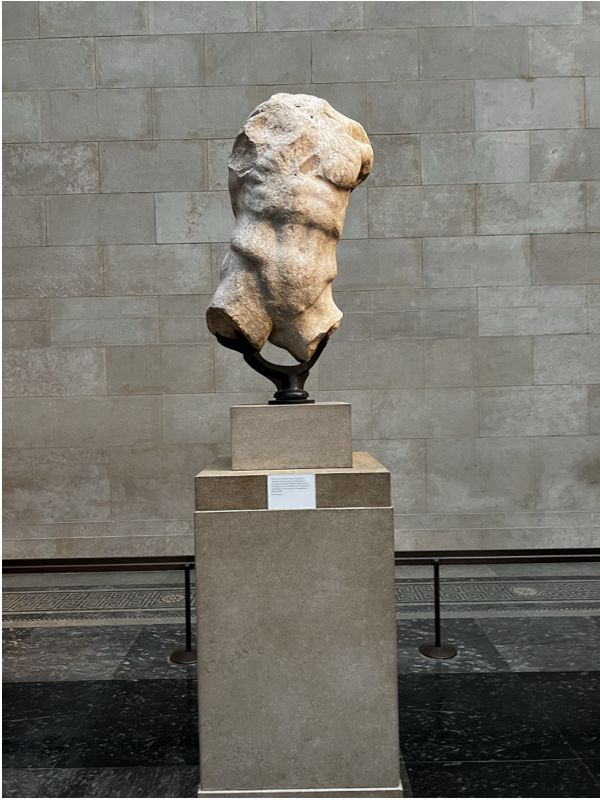
Figure 1. Kishore, Divya. Picture of a battered torso, presumed to be Hermes from the British Museum, 2023.
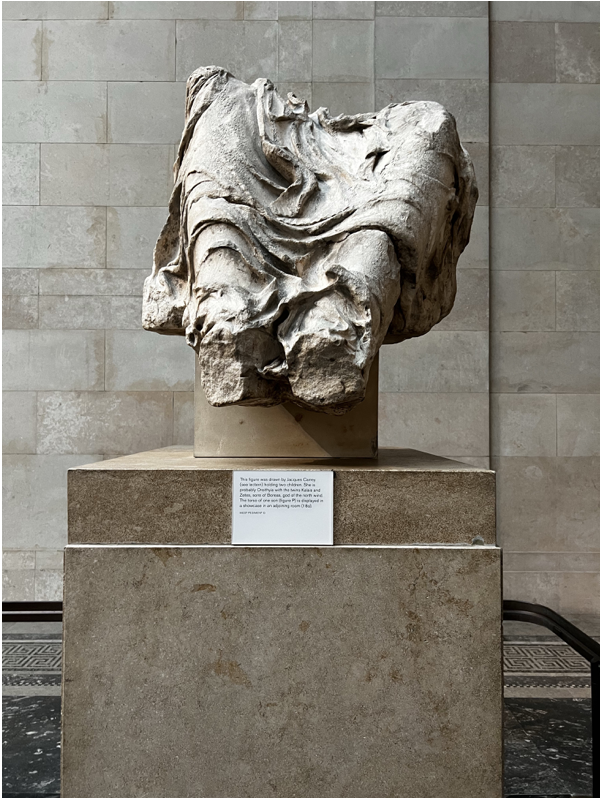
Figure 2. Kishore, Divya. Picture of a battered torso, presumed to be Oreithyia from the British Museum, 2023.
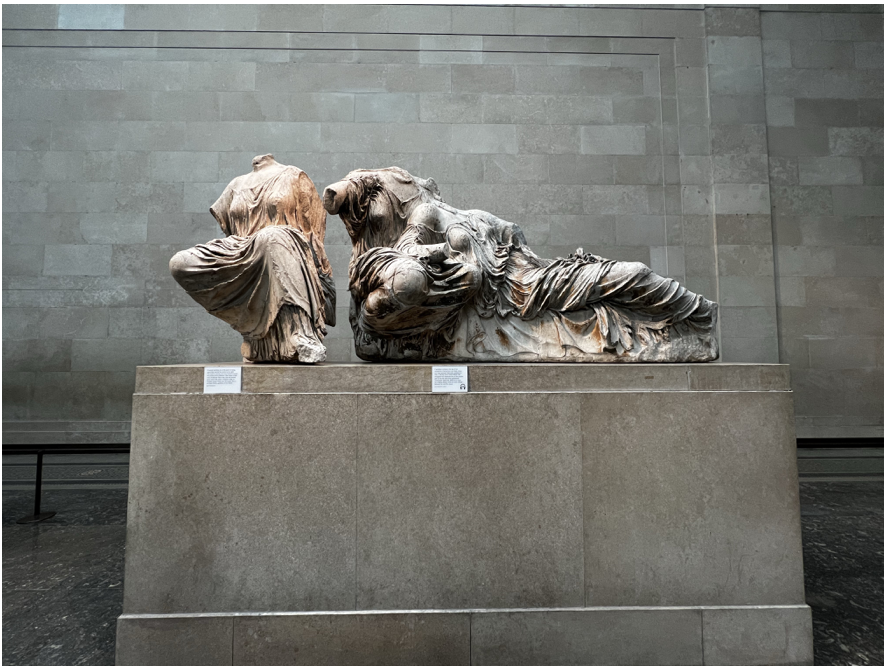
Figure 3. Kishore, Divya. Picture of a battered torso, presumed to be Hestia, Dione and Aphrodite from the British Museum, 2023.
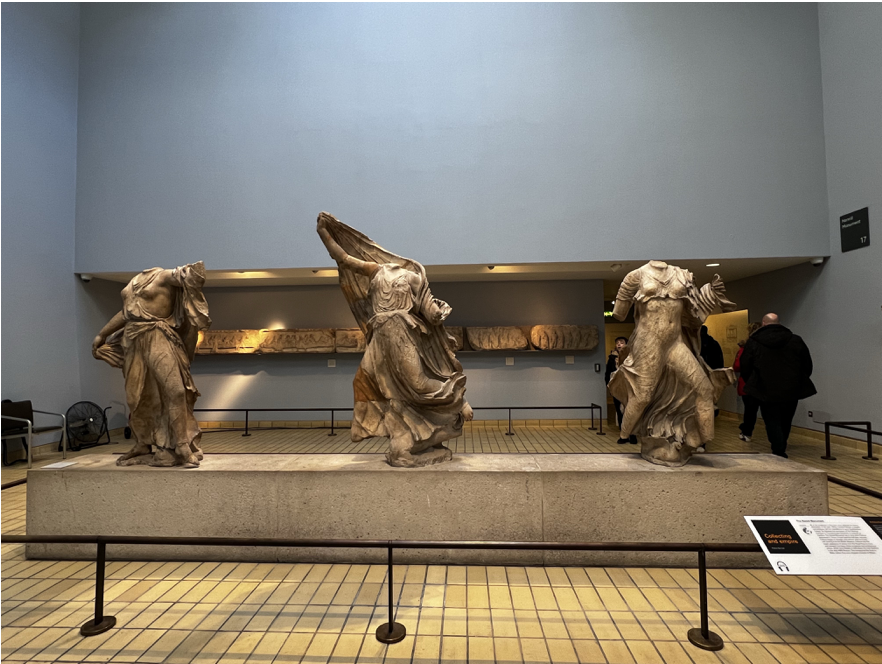
Figure 4. Kishore, Divya. Picture of sculptures in the Nereid monument room from the British Museum , 2023.
In Peter Osborne’s ‘Starting Up All Over Again: Time and Existence in Some Conceptual Art of the 1960s,’ he asks the question about what the present means when questioning the life and death of an object. Bringing up the idea of “understanding of works as structures of temporalization,” a contemporary understanding of Kant’s “quickens” the mind. The suggestion that interacting, responding, questioning temporalizes the artwork. Over here, temporalization means being put into time, thus into life. Their aliveness is through this interaction. However, this mode of responding and questioning is not stagnant due to the role of the present. This artwork that was in the present will eventually take their place in the historical. What keeps the artwork, art movement, art style alive is its ability to restart itself, its role is to be relevant even if it doesn’t mean the same thing. Relevant even more because of its metamorphosis. Or to quote Gatson Bachelard from Osborne’s text, “what has most duration is what is best at starting itself up all over again.”[13] In the case of the Parthenon Sculptures their relevance is maintained through their evolving role in the historical local narratives, them being brought out of these local narratives, creating an international narrative to justify and bolster this departure of them from their site, leading to them overlaying as well as creating local mythologies and memories.
The above mentioned is observed and broken down with some detail in ‘Stories from exile: Fragments from the cultural biography of the Parthenon (or ‘Elgin’) marbles’ by Yannis Hamilakis among others. The Athenian Acropolis was set in motion by Pericles in the fifth century B.C., the very beginning of the narrative. This temple was perhaps Pericles way of embedding the victory of Athens over Persians through the act of competing in artistic and architectural consumptions, creation and production. Hamilakis hypothesises that even though the subject matter decorating the walls do not directly mention the Persian wars, the chosen themes allude to Athenian might and its fight against the other. In this context the other are the Centaurs and Amazons, a symbolism for the third barbaric other, the Persians.[14] Sustaining its first significant injury during the Heruli invasion in 276 A.D., later restored. Theodosius II passed an edict in 435 A.D. imposing cessation of worship in pagan temples across the Roman Empire.[15] Converted into an Orthodox Church in 6th century A.D., the metopes subject to defacement due to themes being ill-suited to its new cultural role and significance. 12th century A.D. saw the monument housing Christian paintings as part of the Orthodox iconographic tradition interacting with the sculptures. Next century witnessed the Parthenon turn into a catholic church, the cathedral of Athens, after the conquering of Greece by the forces of the fourth Crusade. Turning into a mosque in the 15th century by the Ottomans attaching a minaret, the Erechtheion becoming a Harem. Later part of 1600s observed the worst felling of the Parthenon due to the Morean, Ottoman-Venetian war. Ottomans storing explosives with the belief that the monument would not be attacked due to its sacred status, Venetians heavily damaging it despite that. A smaller mosque built after the end of the war.[16] By this time, in the same century, Classicism was being established as the principal ideology within the western aristocratic echelon. The looting framed as collecting and saving had already begun, along with the production of written material like travel journals. Beginning of the 19th century, Thomas Bruce, Lord Elgin, with an alleged firman whose contents cannot be confirmed or verified, took up the project of saving Parthenon sculptures by removing 52 reliefs, 15 metopes, along with the sculptures in the pediments. This had belonged to Elgin for a period of time, during which it changed hands, fragments landing in the Louvre, the Vatican, Austria, Germany and Denmark. Some fragments were displaced during the earlier Morean war, maybe even earlier,[17] fragments becoming a part of houses, adorning the doorways due to the belief of them being sacred votives.[18] About half of the Parthenon Sculptures procured and transported by Elgin to Britain were soon acquired by the British government, becoming a vital part in the creation of the British national identity.[19] The myth making of the Athens, a free country with unsurpassed seafaring might much like Britain. Scholars trying to trace back roots to this civilisation, stating that greeks in Greece cannot have any claim to this due to various forces that conquered the country after, but white christians might.[20] Imposing the narratives that the Hellenes left the marble sculptures unpainted as a pointed gesture. Something we are learning to be untrue and a constructed myth, serving purposes of sowing ideas of racial superiority.[21] Britain stating that Greece is unequipped to take care of the sculptures while the gallery that houses these sculptures in the British Museum has notoriously been known for having leaks and improper maintenance. Acropolis museum specifically being built in retaliation to Britain’s condescension. Hellenes capable of harbouring the birthplace of civilisation, but no more capable of the same civility and sophistication.[22] The fabrication of every empire after Pericles’s Acropolis being a violent invasion, displacement and rupture by them (Macedonians, Romans, Byzantines and the Ottomans), the glory only being restored by Greek independence from these forces.[23] Classical antiquity used as a symbol of validating these ideas during the 19th century and thus forth. Hamilakis falls victim to this as well, calling the Erechtheion, the Caryatid temple, a Harem, something that is unpacked by J.Z.Van Rookhuijzen. He puts forth the notion that this form of language and discourse further embeds ideas of all of the empires being a violent other with no reverence towards what was considered sacred, erasing their interaction with and around the parthenon, a form of antagonistic narratives. Referring to the Caryatid temple as a harem leans into negative stereotypes, a discourse that belongs to a wider narrative of hostility toward the Ottomans and muslims.[24]
Through this all, we are asked to imagine the object when it was created, before injury, before illness, before disability. To imagine what it was when it was first made under the orders of Pericles, before the Macedonians, Romans, Byzantines, the Ottomans, Britain. Before all of this other history. To imagine them before their headless-ness, limbless-ness, colour still considered too garish, not sophisticated enough. Imagining, re-constructing the whole, something that is explored by Davis. He proposes that disability is a rupture in the sensory field. Expounding on this through the Venus tradition, identified by Kennet Clark as ‘the body re-formed’. No Venus preserved is intact, but Art historians and critics over-look this absence creating the whole, restoring damage through an act of imagination. Though, this restoration is not a form of creating the exact historical replica, it is an idealised version, a mythologised narrative.[25]
The Parthenon Sculptures bear the illness of being a classical antiquity carrying symbolic weight in the process of legitimating authority through its cultural capital. The impairments it carries authenticating its cultural function. Even more so because of the way it has been able to restart itself throughout various epochs under all of these various dominating forces. Especially because of the way literature has constructed it in our collective consciousness and memory. Constructing the British national identity along with the Greek identity. Creating memories through these classical antiquities. By asking us to imagine ourselves through a carefully constructed fullness of the parthenon sculptures.
Germany returned a small fragment of a frieze in 2006.[26] Italy returning another fragment in 2021.[27] Austria agreed on returning two fragments in may of 2023.[28] Later that year the Vatican returned three fragments- a horse’s head, a boy’s head, a bearded man.[29] Denmark announcing their refusal to return three fragments- two marble heads and one horse’s hoof. Dr Christian Sunne Pedersen, the Danish National Museum’s Head of Research asserting, the fragments on display are of great importance in showcasing Danish “cultural history,” their interaction with the world around them “at a time when democracy was forming.”[30] Britain insisting that Elgin’s acquisition of the Parthenon Sculptures was throughly vetted at that time, consequently British museum’s ownership over them is rightful. Expressing that them being a universal museum places these objects in the context of the universe, the world having better access to these objects as the viewership of the British Museum is much higher compared to the Acropolis museum.[31] In the background there is a massive restoration project of the Acropolis monuments with the intention of rehabilitating the parthenon to its original state. Something that has come under massive scrutiny, Hamilakis maintains in a recent statement, “what is being reconstructed is an Acropolis of whiteness, of the Euro-centric, Western fantasy; an Acropolis as built by philologists, architects and archaeologists in the 18th and 19th centuries; an Acropolis of colonial-national modernity and romantic nationalism.” If it were not the case then the Parthenon would be painted instead of being left white.[32]
What would a good death for objects like this look like? What kind of euthanasia should they be subject to? Furthermore, who gets to decide?
Currently all of these objects (that we know of) are in various museums, with the exception of the site itself. Though even the site is subject to restoration and maintenance much like the objects in the museum. What does the museum do for objects like this would be a good question to begin with. In ‘Valery Proust Museum,’ Adorno remarks, “museums are like the family sepulchres of the works of art,” drawing connections between the word mausoleum and museum.[33] Analysing and juxtaposing Valery and Proust’s museum, the way they interact with the same. For Valery, the museum is the after life, the rules of the museum making the whole process uncomfortable, distancing the artwork, making it harder to enjoy. Art is lost when it no more has a place in the immediacy of life, its functional context. Whereas for Proust it is the very afterlife that gives art meaning. It becomes a part of the consciousness of the audience. The death of the intention of the work is necessary for it to be enjoyed.[34] The art object is not really dead in either case, they are still suspended alive by the act of temporalization. But, removing the objects from public eye, from constant interaction, putting them in storage, still maintained, still present in the same plane of existence as ours gives it the ability to come back to life when re-discovered or saved. The museum is a form of life support, very much like the machines keeping Hisashi Ouchi’s body alive. What needs to come to an end is the mythologised narrativising. This narrative that is mythologised creates a need to attempt at the mythologised narrative. The act of imagining a carefully constructed totality forces relevance to classical antiquity. It imbues it with symbolic power leading to every molecule of it holding unsurpassable cultural economy and the ability to legitimate authority. Its disability and pain becoming reasons to not euthanise.
None of the questions posed in the conclusion are easily resolvable with the current political state. However, what can be argued is that this very essay, through the act of trying to look at the way the object is constantly temporalized is participating in the act of keeping the object alive. Even asking the question of at what point can you euthanise an art object partakes in the process of necessitating the preservation of the object’s physical materiality. We need the object alive to tell us why it needs to die.
Footnotes
[1] NHK-TV “Tokaimura criticality Accident” Crew, A slow death: 83 days of radiation sickness, 87.
[2] NHK-TV “Tokaimura criticality Accident” Crew, A slow death: 83 days of radiation sickness, 11-27 & 65-111.
[3] NHK-TV “Tokaimura criticality Accident” Crew, A slow death: 83 days of radiation sickness, 51.
[4] NHK-TV “Tokaimura criticality Accident” Crew, A slow death: 83 days of radiation sickness, 112-122.
[5] Kalaivani Annadurai, et al, “Euthanasia: Right to Die with Dignity,” 477-478.
[6] Kalaivani Annadurai, et al, “Euthanasia: Right to Die with Dignity,” 477-478.
[7] Kalaivani Annadurai, et al, “Euthanasia: Right to Die with Dignity,” 477-478.
[8] NHS, “Euthanasia and Assisted Suicide.”
[9] Kalaivani Annadurai, et al, “Euthanasia: Right to Die with Dignity,” 477-478.
[10] Elaine Scarry, The Body in Pain, 1-23.
[11] According to the medical model of disability, it is the physical/mental impairment that is wrong with the body: people with disabilities. Definition rephrased from: Shakespeare, Watson, “The Social Model of Disability: An Outdated Ideology?” 9-28.
[12] Lennard J. Davis, “Visualising the Disabled Body: The Classical Nude and the Fragmented Torso,” 126-157.
[13] Peter Osborne, “Starting Up All Over Again: Time and Existence in Some Conceptual Art of the 1960s,” 91-106.
[14] Yannis Hamilakis, “Stories from exile: Fragments from the cultural biography of the Parthenon (or ‘Elgin’) marbles,” 306.
[15] Redazione. “The Whole Story of the Parthenon Marbles: From British Removal to Today’s Debate.”
[16] Yannis Hamilakis, “Stories from exile: Fragments from the cultural biography of the Parthenon (or ‘Elgin’) marbles,” 306.
[17] Redazione. “The Whole Story of the Parthenon Marbles: From British Removal to Today’s Debate.”
[18] Yannis Hamilakis, “Stories from exile: Fragments from the cultural biography of the Parthenon (or ‘Elgin’) marbles,” 307.
[19] Debbie Challis, “The Parthenon Sculptures: Emblems of British national identity,” 33-39.
[20] Debbie Challis, “The Parthenon Sculptures: Emblems of British national identity,” 33-39.
[21] Margaret Talbot, “The Myth of Whiteness in Classical Sculpture.”
[22] Yannis Hamilakis, “Stories from exile: Fragments from the cultural biography of the Parthenon (or ‘Elgin’) marbles,” 303-320.
[23] Debbie Challis, “The Parthenon Sculptures: Emblems of British national identity,” 33-39.
[24] Rookhuijzen, Janric van. “The Turkish Harem in the Karyatid Temple and Antagonistic Narratives on the Athenian Acropolis,” 341-360.
[25] Lennard J. Davis, “Visualising the Disabled Body: The Classical Nude and the Fragmented Torso,” 126-157.
[26] Martin Bailey, “Germany’s Heidelberg University Returns Parthenon Fragment to Greece.”
[27] Angela Giuffrida, “Italy Returns Parthenon Fragment to Greece amid UK Row over Marbles.”
[28] Taylor Dafoe, “Austria Will Return Two Small Parthenon Marbles to Greece. Officials Hope the Move Will Encourage Britain to Follow Suit.”
[29] Sarah Cascone, “The Vatican’s Parthenon Marble Fragments Have Officially Entered the Collection of the Acropolis Museum in Athens.”
[30] Duncan Howitt-Marshall, “National Museum of Denmark to keep Parthenon fragments.”
[31] Solomon, Tessa. “How Did the Parthenon Marbles End up in the British Museum?”
[32] McGreevy, Nora. “Why Proposed Renovations to Greece’s Acropolis Are so Controversial.”
[33] Theodor W Adorno, “Valery Proust Museum,” 175.
[34] Theodor W Adorno, “Valery Proust Museum,” 175 - 185.
List of Images
Figure 1. Kishore, Divya. Picture of a battered torso, presumed to be Hermes from the British Museum, 2023. Photograph. Source: Picture taken by Divya Kishore while visiting the British Museum.
Figure 2. Kishore, Divya. Picture of a battered torso, presumed to be Oreithyia from the British Museum, 2023. Photograph. Source: Picture taken by Divya Kishore while visiting the British Museum.
Figure 3. Kishore, Divya. Picture of a battered torso, presumed to be Hestia, Dione and Aphrodite from the British Museum, 2023. Photograph. Source: Picture taken by Divya Kishore while visiting the British Museum.
Figure 4. Kishore, Divya. Picture of sculptures in the Nereid monument room from the British Museum , 2023. Photograph. Source: Picture taken by Divya Kishore while visiting the British Museum.
Bibliography
“The Progress of the Work ‘Restoration and Conservation of the Acropolis Monuments’ NSRF 2014-2020.” YSMA, June 22, 2022. https://www.ysma.gr/en/news/%CE%B7-%CF%80%CF%81%CF%8C%CE%BF%CE%B4%CE%BF%CF%82-%CF%84%CE%BF%CF%85-%CE%AD%CF%81%CE%B3%CE%BF%CF%85-%CE%B1%CE%BD%CE%B1%CF%83%CF%84%CE%B7%CE%BB%CF%89%CF%83%CE%B7-%CE%BA%CE%B1%CE%B9-%CF%83/. Abrams, Amah-Rose. “In a Breakthrough, Italy Will Return a Piece of the Parthenon Frieze to Greece under a Long-Term Loan Agreement.” Artnet News, December 1, 2021. https://news.artnet.com/art-world/parthenon-greece-swap-italy-2042252.
Abrams, Amah-Rose. “In a Breakthrough, Italy Will Return a Piece of the Parthenon Frieze to Greece under a Long-Term Loan Agreement.” Artnet News, December 1, 2021. https://news.artnet.com/art-world/parthenon-greece-swap-italy-2042252.
Adorno, Theodor W. “Valery Proust Museum.” Prisms, 1982. https://doi.org/10.7551/mitpress/5570.003.0012.\
Annadurai, Kalaivani, Raja Danasekaran, and Geetha Mani. “′Euthanasia: Right to Die with Dignity′.” Journal of Family Medicine and Primary Care 3, no. 4 (2014): 477-478. https://doi.org/10.4103/2249-4863.148161.
Bailey, Martin. “Germany’s Heidelberg University Returns Parthenon Fragment to Greece.” The Art Newspaper - International art news and events, September 28, 2021. https://www.theartnewspaper.com/2006/02/01/germanys-heidelberg-university-returns-parthenon-fragment-to-greece.
Cascone, Sarah. “The Vatican’s Parthenon Marble Fragments Have Officially Entered the Collection of the Acropolis Museum in Athens.” Artnet News, March 27, 2023. https://news.artnet.com/art-world/vatican-parthenon-marble-fragments-returned-greece-acropolis-museum-2275942.
Challis, Debbie. “The Parthenon Sculptures: Emblems of British National Identity.” The British Art Journal 7, no. 1 (2006): 33–39. http://www.jstor.org/stable/41614663.
Dafoe, Taylor. “Austria Will Return Two Small Parthenon Marbles to Greece. Officials Hope the Move Will Encourage Britain to Follow Suit.” Artnet News, May 3, 2023. https://news.artnet.com/art-world/austria-reptriates-two-small-parthenon-marbles-to-greece-2294596.
Davis, Lennard J. “Visualising the Disabled Body: The Classical Nude and the Fragmented Torso.” Essay. In Enforcing Normalcy: Disability, Deafness, and the Body, 126–57. Kbh.: Nota, 2016.
Giuffrida, Angela. “Italy Returns Parthenon Fragment to Greece amid UK Row over Marbles.” The Guardian, January 5, 2022. https://www.theguardian.com/artanddesign/2022/jan/05/italy-returns-parthenon-marbles-fragment-greece-uk-row.
Hamilakis, Yannis. “Stories from Exile: Fragments from the Cultural Biography of the Parthenon (or ‘elgin’) Marbles.” World Archaeology 31, no. 2 (1999): 303–20. https://doi.org/10.1080/00438243.1999.9980448.
Howitt-Marshall, Duncan. “National Museum of Denmark to Keep Parthenon Fragments.” eKathimerini.com, November 28, 2023. https://www.ekathimerini.com/culture/1225880/national-museum-of-denmark-to-keep-parthenon-fragments/.
McGreevy, Nora. “Why Proposed Renovations to Greece’s Acropolis Are so Controversial.” Smithsonian.com, April 29, 2021. https://www.smithsonianmag.com/smart-news/why-proposed-renovations-greeces-acropolis-are-so-controversial-180977620/.
Meier, Allison C. “Wait, Why Are the Parthenon Marbles in London? - JSTOR DAILY.” JSTOR DAILY, December 1, 2019. https://daily.jstor.org/wait-why-are-the-parthenon-marbles-in-london/.
NHK-TV “Tokaimura criticality Accident” Crew. A slow death: 83 days of radiation sickness. Translated by Maho Harada. New York: Vertical, 2015. https://archive.org/details/ASlowDeath83DaysOfRadiation/page/n5/mode/2up.
NHS. “Euthanasia and Assisted Suicide .” NHS. Accessed December 15, 2023. https://www.nhs.uk/conditions/euthanasia-and-assisted-suicide/.
Osborne, Peter. “Starting Up All Over Again: Time and Existence in Some Conceptual Art of the 1960s.” Essay. In The Quick and the Dead, edited by P Eleey, 91–106. Minneapolis: Walker Art Center, 2009.
Redazione. “The Whole Story of the Parthenon Marbles: From British Removal to Today’s Debate.” Finestre sull’Arte, June 4, 2022. https://www.finestresullarte.info/en/works-and-artists/the-whole-story-of-the-parthenon-marbles-from-british-removal-to-today-s-debate.
Rookhuijzen, Janric van. “The Turkish Harem in the Karyatid Temple and Antagonistic Narratives on the Athenian Acropolis.” Opuscula 14 (2021): 341–62. doi:10.30549/opathrom-14-16.
Scarry, Elaine. The body in pain: The making and unmaking of the world. New York, New York: Oxford Univ. Press, 2006.
Shakespeare, Tom. Watson, Nicholas. “The Social Model of Disability: An Outdated Ideology?” Research in Social Science and Disability 2 (2002): 9–28. https://doi.org/10.1016/s1479-3547(01)80018-x.
Solomon, Tessa. “How Did the Parthenon Marbles End up in the British Museum?” ARTnews.com, December 12, 2023. https://www.artnews.com/art-news/news/parthenon-marbles-british-museum-restitution-1234605904/.
Talbot, Margaret. “The Myth of Whiteness in Classical Sculpture.” The New Yorker, October 22, 2018. https://www.newyorker.com/magazine/2018/10/29/the-myth-of-whiteness-in-classical-sculpture.
Grades and Feedback
Grade: 79/100
Graded on: 19 February 2024.
Graded by: Yaiza Hernandex Velazquez
This submission was thrilling to read. There is a tour de force here, as you try to bring your readings on pain and euthanasia to bear on the fragments of The Parthenon. I was dazzled and frankly, impressed, by your assured writing at the outset. It is, and I think you know this, an essay that is not fully resolved here, but this is not a measure of its shortcomings, but rather of its ambition. I think this is an essay that merits reworking and eventually even publishing, and this is not something that undergraduate essays often achieve.
There are some readings that might be useful if you do want to continue thinking about these issues, in particular, writings on the fragment as Romantic trope, and perhaps a more developed understanding of the relationship between death and autonomy in art.
All of this, however, would be for a future development of what has been submitted here which remains, for the purpose of this assignment, an extraordinary offering.
My Reflections
I struggled quite a bit to write this piece. The module was hard to grasp, and I was about unsure how to apply the philosophy taught in the module. There was a desire to experiment with dense art philosophy and art history, entangling them with the medical model of disability, but I didn’t know how yet. Then I came across Hisashi Ouchi and the Parthenon Marbles.
The writing in this essay is convoluted; it makes me cringe in disbelief. But it also forces me to accept that writing happens even when I'm brain-fogged and in ill health. Writing, the style and the convolutedness of it, is sometimes a manifestation of burnout, exhaustion, disinterest and other such physical and mental feelings.
In this essay, the rich philosophy and ideas are there, but I learnt that I needed to focus on the more basic stuff—sentence structure, grammar, academic convention, amongst other things. It was sitting with this essay that made me realise what I needed to focus on. Critical thinking skills, while essential, need to be supplemented with clear writing skills. The reason I say this is because, essays in the humanities, and in any other field for that matter, are about persistently and adequately convincing the wider public that your research, your research findings, and the methodology have merit. That is the writing part; the research itself requires a different kind of persistent effort that is rigorous and reflective.
However much I struggled with this essay, I still quite enjoyed writing it. The philosophy, while dense and convoluted, required a mental rigour that I do not always have the capacity for, but want to engage in nonetheless. I would like to pursue this topic further in my Master's programme, whenever I get to it.