How did Bob Flanagan and Sheree Rose’s relationship orient, dis-orient and re-orient itself towards Bob Flanagan’s pain?
This is the Essay I submitted for the module ‘Frontiers of Performance’ in the academic year 2023-2024. Grades, feedback, and my reflections are at the end.
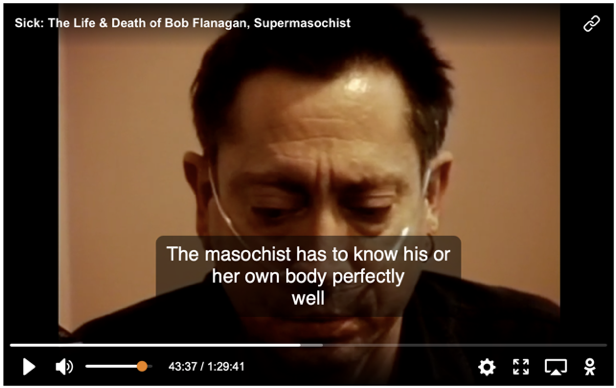
Fig 1. Kirby Dick (Dir), Still from film Sick: The Life & Death of Bob Flanagan, Supermasochist, 1997.
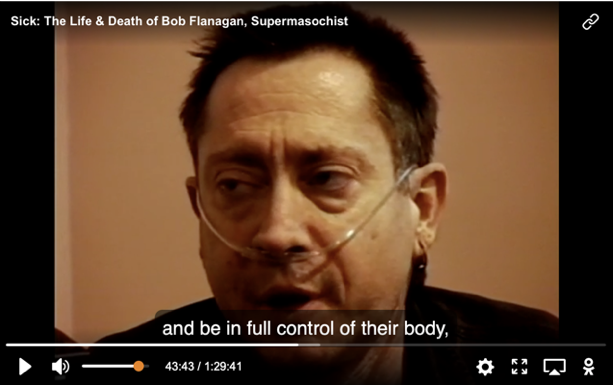
Fig 2. Kirby Dick (Dir), Still from film Sick: The Life & Death of Bob Flanagan, Supermasochist, 1997.
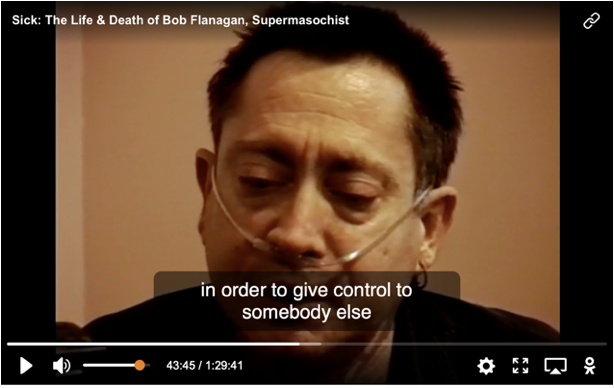
Fig 3. Kirby Dick (Dir), Still from film Sick: The Life & Death of Bob Flanagan, Supermasochist, 1997.
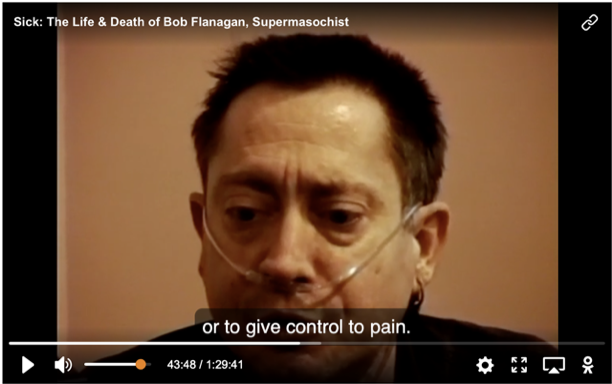
Fig 4. Kirby Dick (Dir), Still from film Sick: The Life & Death of Bob Flanagan, Supermasochist, 1997.
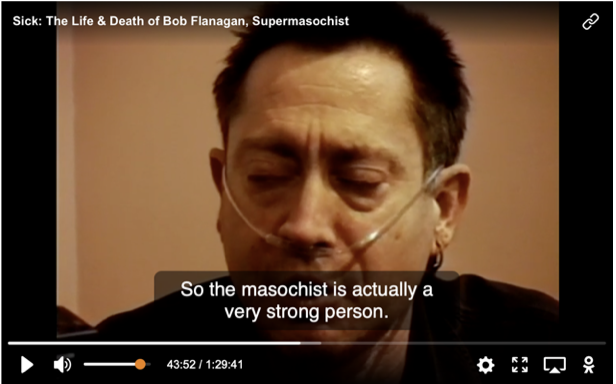
Fig 5. Kirby Dick (Dir), Still from film Sick: The Life & Death of Bob Flanagan, Supermasochist, 1997.
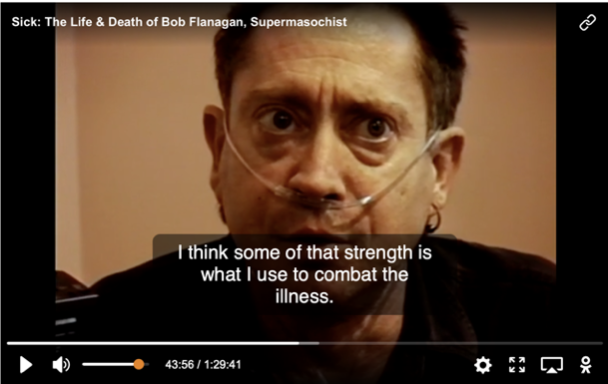
Fig 6. Kirby Dick (Dir), Still from film Sick: The Life & Death of Bob Flanagan, Supermasochist, 1997.
“If every orientation is preceded by another orientation, then this also means that orientation is temporal in itself. As far as orientation always deals with new circumstances, new situations, and never-ending change, it also deals with time, and its function is thus to find its way with time. …in a self-referential way, orientation is always an orientation about time, or—to put it shortly—an orientation for a time.” - Werner Stegmaier [1]
“Our question becomes not so much what is pain, but what it does, what affects does it have on how bodies inhabit the world made up of other bodies.” - Sara Ahmed [2]
Preamble: Werner Stegmaier describes orientation as something that is understood to be an “achievement in finding one’s way in a new situation.” Elucidating further in a later chapter that, Orientation was the mastery attained over a situation through the exploration of said situation. It is the ability to gain the most out of the circumstances, being able to do what is ‘right’ in response to relevant contingencies with a recognition that the current response changes the parameters of orientation, necessitating a re-orientation. These small fissures in orientation are a form of dis-orientation, instigating a continuous process of re-orientation. When this continuous process of re-orientation fails that’s when the dis-orientation becomes overwhelming.[3] If we were to apply this logic to Bob Flanagan’s illness (Cystic Fibrosis) and the pain this illness caused, the relevant question is, “What are the footholds of orientation to, re-orientation to, and dis-orientation from, his pain?” rather than, “what is his pain?”.
Bob Flanagan contextualized his masochistic explorations in his formative years as a form of autonomy over the pain his illness caused; an amalgamation of grappling with being a catholic, his feelings of only being loved when he was in pain, as well as a person with extreme sexual fantasies. During his relationship with Sheree Rose, he delves deeper into this idea of masochism as both a form of autonomy over pain and a process of gaining a deeper understanding of his body.[4] It was when the relationship was brought into the public realm through their art that an analysis of how Flanagan and Rose’s relationship subverted the Sadean and explored the Freudian regimes, as well as, the de-sexualisation of disabled bodies in society was developed.[5] All of these orientations were being formed in response to Flanagan’s pain which, in itself, was in the constant process of transformation. The reason why I want to focus on the ways in which Flanagan and Rose’s relationship orients, dis-orients, and re-orients itself towards Flanagan’s pain is because Flanagan didn’t exist in isolation with his pain. It is not only how he oriented himself to his pain, but also about how this pain existed, and transformed, between him and the people around him that is important—exactly like what Sara Ahmed is trying to say in the quote above.
When the orientation of Flanagan and Rose’s relationship towards his pain is explored through the concept of orientation, my orientation gets interpolated into theirs. While his pain was the thing that was being oriented to by him and the people around him, I am orienting to his pain and the way his relationship with Rose oriented to his pain through the Film Sick: The Life and Death of Bob Flanagan, Supermasochist; Werner Stegmaier’s concept of, orientation, re-orientation and disorientation;[6] Elain Scarry’s theorisations that the other’s pain is ungraspable while our pain is graspable which leads to pain evading and deconstructing language, because pain itself does not have any adjectives of its own it requires the usage of weapon and wound (imagined or actual) to communicate it;[7] and Sara Ahmed's counterpoint to Scarry that, it is not only the other’s pain that is ungraspable but also our own, along with her proposition that we should be capable of imagining pain in the other beyond our own understanding and experience of it.[8] The usage of 1st person language is a necessary acknowledgement of, and emphasis on, my orientation to their (Flanagan and Rose) orientation to Flanagan’s pain. As well as, an admittance to personal relatability of Flanagan’s theorisation of masochism as a form of autonomy over pain as a body that experiences chronic pain and has chronic illnesses.
——————————
Elaine Scarry proposes that “physical pain does not simply resist language but actively destroys it, bringing about an immediate reversion to a state anterior to language, to the sounds and cries a human being makes before language is learned.”[9] This destruction of language exists in between the graspability of one’s own pain versus the un-graspability of the one’s pain by the other. Using Sophocles’s agonised Philoctetes uttering a barrage of cries and shrieks that can only be translated into “ah” with a varying number of exclamation marks for emphasis, Scarry makes a totalising statement that the shyness of a language and people aside, there is a fundamental resistance that all languages have to pain that is foundational to the construction of pain.[10] The intervention I wish to make to a totalising statement like that is: pain does not evade language but a form of translation, not only from one language to another, but from one language to the very same, from one body to the very same. Pain evades a translation of experience from one person to another as the “sounds and cries” are not anterior to language, it is a form of language on its own. The burden of understanding these sounds and cries falls on the other who seeks a decipherable explanation of the interiority of a body for either compassionate understanding, a transformation of this pain into something that is not pain through medical intervention, or for any other socio-political reasoning.
However, it is understandable why Scarry would approach pain in such a manner as throughout the book, she is describing the pain of others and how that exists within various socio-political dynamics through the analysis of torture.[11] When that distinction between clarity of experience versus the obfuscation of the same in the form of language is necessary for a theoretical interpretation, there is a segregation between the thing that she calls before language and a translation of an interior experience of the body to an exterior form of communication which makes this interiority available to the other. One could argue that Scarry is unable to imagine the expression of pain in any other way except comprehensible language because of her methodology and specific distance from the body/bodies she is talking about. As well as her own position of speaking for others which mirrors her statement that, where there is failure when expressing pain by the person in pain, the people around them take on the role of elucidation for them.[12] This positionality of being an other to the experience of pain can be observed with Sara Ahmed as well.
Ahmed explains, through the way her body experiences pain that, pain is a moment of tuning into the body. Till that moment of pain-feeling the body is absent as it is constantly outside itself, occupied by all its various involvements with other people. Ahmed explores pain by describing how a nail pressing into her foot feels like and what period pain feels like. Further explicating her orientation to her mother’s pain (misdiagnosed as Multiple Sclerosis, later diagnosed to have transverse myelitis), what that relationship was like and what her mother needed from Ahmed in that long journey of pain. Then talking about the experience of indigenous Australians, recounting stories of children being taken away into boarding schools. There is a powerful statement about being a witness to the pain of others, about allowing the pain of others to affect us. This is where she makes the intervention—it is not only the other’s pain that is un-graspable, but also our own because of this body-mind separation that we are conditioned into. When considering the conditioning as foundational, then the graspability of the other’s pain needs imagination; the ability to imagine beyond one’s personal experience and encounter of it.[13]
There are a few counterpoints I would like to make to Ahmed’s explorations on pain. Her statement that pain is a moment of the body becoming aware of itself works particularly well for people who do not experience chronic illness and/or pain in a consistent and constant (I can trust it to be there in some manner or another through my lifetime), impairing and evolving (I can trust it to flare up, flare down and transform over time leading to moments/periods of impairment) manner. The absent body is not a possibility when pain is a core part of a body’s experience. In fact, there is a necessity for greater attunement to the body that is demanded when pain is a central sensation to said body because pain is not a stagnant experience, but one that is capricious and ever-changing. What is happening here is the opposite of the absent body, it is the present body. At that moment, the witness’s role is not only to acknowledge the interior experience of pain in the other but also to show that there is such a thing as the absent body.
Ahmed mentions that pain is socially constructed as a lonely experience. The experience of pain is not private only because of the social construction of it as a lonely experience, it is also due to pain being contrived as a thing that is aversive. This fabrication of pain is seen in Ahmed’s description of pain as something that is against, something to be pushed out, moved away from, something that should not be an experience.[14] A formulation also observed in Scarry’s The body in Pain, where she discusses the etymological root of pain (“poena” — punishment), expanding on a quote by Michael Walzer which says: he couldn’t imagine infinite pain “without thinking of whips and scorpions and hot irons and other people.”[15] I would like to attach shame to Scarry’s construction as ideas of punishment also accompany feelings related to and/or of trauma, shame, and fear. Michael McIntyre argues this approach to pain is not broad enough in today’s context. One of the examples he gives is activities like sports and dance. Pain is an intrinsic part of these activities, a necessary obstacle to overcome and embrace in the process of mastering the activity.[16] These three writers demonstrate something specific about pain, its nuanced existence and experience within the individual and the society. They demonstrate a necessity for a translation of pain between bodies because of subjective and complex involvement with, and exposure to, pain. In this instance, the witness capable of experiencing the absent body and the person with a body that is always present, demonstrates the necessity for a translation of pain in between them.
The statement that we are incapable of grasping not only the other’s pain but also our own is as subjective as the statement our pain is graspable while the other’s is not. Both of these statements can be, on an individual experiential level, true. The above two paragraphs might have created a binary: the witness as never in pain, the present body as always in pain. If we think of pain as a moving spectrum, the witness experiences pain in a different way when compared to someone who lives with chronic pain. There needs to be a pluralising when it comes to the experience of bodies, and a confession of how personalised these feelings, sensations, and experiences are, not lending themselves well to a theory that is universal. What can be achieved is a translation of pain between bodies that allows for a graspability of a pain, something more phenomenological with an explicit recognition that it is not only the translation of pain that needs to be oriented to, but the translation itself requires situational orientations and re-orientations. I want to refer back to the intervention I wished to make to Scarry’s “pain evades language,” I want to propose that pain evades constant translation between bodies that experience pain differently. I would like to explore this idea through Flanagan and Rose’s relationship as documented in the film: Sick: Bob Flanagan’s Life and Death, Supermasochist.
This film—directed by Kirby Dick in collaboration with Rose and Flanagan—was released in 1997, a year after Flanagan’s death. It documented Flanagan’s poetry, comedy, and performance art that was done in collaboration with his mistress and lover, Sheree Rose. In addition, the film recorded Flanagan’s lifelong journey with Cystic fibrosis (CF), a hereditary disease causing the over-production of thick, sticky mucous, as well as other symptoms and co-morbidities affecting the entire body.[17] People with CF, during Flanagan’s lifetime, were not expected to live past their early 20s, he lived to 43. There were interviews with Flanagan, Rose, Flanagan’s parents and brother, Sara (a young woman with cystic fibrosis getting the chance to meet Flanagan through the Make-a-Wish Foundation, Canada), and her mother, done by the production team.[18]
Flanagan had often referred to CF and his explorations with Masochism as twin maladies, masochism giving him the strength to beat the pain of CF; “beat sickness with sickness,” a phrase he repeatedly used to describe that interconnection between his masochism and CF.[19] [20] Masochism was his way of orientation, both to grasp his pain, as well as to subvert it. What I mean by that statement is that—Masochism was a way to understand the limits of his body, an exploration of how much pain his body could tolerate. The subversion of his CF pain came through his capacity to derive pleasure from his masochistic endeavours. The film showed him narrating his investigation of this theorisation of autonomy over, and subversion of, pain from a very young age through performing acts of bondage and self-flagellation. When he meets Rose, he takes this orientation of pain—in addition to his sexual fantasies—to her, they form a twin orientation to Flanagan’s pain. Masochism allows for the formulation of a translation of pain between Flanagan and Rose, which they then take to the public through their performance art. However, later in their relationship, Flanagan asks for a re-orientation to his pain that had evolved from the time of their meeting. This is when Rose is not able to re-orient to Flanagan’s evolving pain; a moment of dis-orientation showcasing that even though the translation of pain is possible, it evades constant and consistent translation. I would like to demonstrate this below through an analysis of the documentary film.
——————————
The film starts with the sound of Flanagan coughing and spitting out phlegm laid over ominous instrumentals. This sound is accompanied by short clips of Rose feeding him from a baby bottle, smacking cake on his face, facial expressions that show pain and/or pleasure, him being blindfolded and gagged, and Rose strangling him with what appears to be rope among other acts of S&M, immediately cutting to a close up of Flanagan reading from a script. Clips from his performance pieces showing the deep social and personal interconnection between his art, pain, life, and death are put together forming the introduction of the film. This is the first line after Flanagan reads from the script, “All the articles about me start that way—Bob Flanagan should be dead by now, but he isn’t. Instead he nails his dick to a board.” Right after, there is a clip of him singing “SupermasochisticBobhascysticfibrosis,” this clip moves in and out, going very close to his face, panning in on his tattoos, nipple rings, varicose veins bulging out in and around his lower abdominal region, and on particular parts of his costume. There is textural closeness to Bob’s sickness because of the cinematography in this clip. The way his face and throat move while he sings, laughs, coughs, adjusts his breathing tube, starts to sing again, coughs again, a cycle of adapting every physical action of his to his sickness. “Any normal person would have buckled from the pain but super Bob got twisted, now he is into whips and chains,” a line from his song where Bob does recognize that his orientation to his pain was (still is) constructed as a mental illness in psychology,[21] but, it is the thing allowing him to tolerate and manage the CF pain.
Though S&M is not the only form of orientation to his pain. The way he dresses, the manner in which he talks, how vocally he breathes, and the equipment he needs to sustain his body like the nasal cannula, the oxygen tank, and the central venous catheter visible in all his performances where his chest is bare could be considered as orientations as well. The argument can be made that these are orientations he did not have agency over as he was diagnosed with CF when he was 18 months old, his body was immediately exposed to medical procedures and equipment deemed necessary to keep him alive by the people around him. The physical remnants of medical procedures and equipment attached to his body could be considered a translating agent of pain. It is keeping him alive while also visually communicating that he needs these things to keep him from succumbing to death due to his sickness.
In the interview with his parents conducted by the production crew, his mother says that all the procedures done on Flanagan when he was young were under local anaesthesia. His pain was numbed just enough for him to know, this was a big thing for her because she remembered him screaming in pain.[22] In the zine (re)claiming Agency: Care, trauma + the medical institution, Greta Sharp, based on her personal experience, introduces the notion of mental illness as a direct outcome of the trauma perpetuated by the medical institution.[23] Building on the same logic, and in an attempt to adapt it to Flanagan, I would like to suggest that S&M was an outcome of wanting to (re)claim agency and translation over a body that was poked and prodded even before the body could be fully conscious of itself. This is not to say that BDSM practices are a sign of mental illness, this is a recognition that extreme sexual practices can be a form of reclaiming body, agency, feeling and memory especially because of its consensual element, and discursive and reflective practices like writing a clear contractual agreement and aftercare practices during which they discuss the event past.[24]
For the first 10 minutes, the film explores Bob Flanagan’s illness and his orientation to his illness, his parents and their orientation to his orientation to his illness. Rose is introduced through a video performance clip titled Leather from Home. In this clip, Flanagan is reading out a letter he writes to his mother stating that he fell in love, laden with visual insinuations of his S&M explorations with Rose. The clip shows Flanagan taking part in D/s (Dominance and Submission) activities with Rose, giving some hints about the relationship contract they might have established between them. A performance video of the contract between Flanagan and Rose directly follows this clip.
“Of my own free will, I, Bob Flanagan, grant you, Sheree Rose, full ownership and use of my mind and body. I will obey you at all times and seek your pleasure and well-being above all other considerations. I renounce my own pleasure, comfort or gratification, except insofar as you desire or permit them. I renounce all rights to privacy or concealment from you. I will answer truthfully to the best of my knowledge any and all questions you may ask. I understand and agree that any failure by me to comply fully with your desires shall be regarded as sufficient cause for severe punishment. I otherwise unconditionally accept as your prerogative, anything you may choose to do with me, whether as punishment for your amusement, or whatever purpose, no matter how painful or humiliating to myself.”[25]
This was the contract between them, this was the orientation their relationship was founded on. There are a series of interviews with Rose and Flanagan, individually and together, in between these performance video clips that discuss how they met, Rose’s childhood, her desires and orientation to S&M, and why she was interested in Flanagan. Flanagan giving context about how he was only interested in specific elements of S&M like degradation and humiliation, among others, due to its consensual element. There is a question I have been reflecting on (and continue to ponder about) every single time I have watched the film over the last year— while there is a clear delineation of what masochism really meant for Flanagan, was there ever a proper conversation between Rose and Flanagan about it that was individual to his fantasies and sexual desires? A conversation about masochism individual to the foothold it was between them? I bring this up because of the above contract and what is said by Rose in the interviews. For her, the D/s relationship between them was very important—Rose taking part in keeping him alive through her role of doling out the dominance and sadism to his submission and masochism—this feels like her orientation. Whereas, for Flanagan, the D/s was part of a larger orientation of and to pain.
There is a clip of Flanagan reading from the Fuck Journals—diary entries Rose had ordered him to write after all of their sexual endeavours— followed by an audio recording of Flanagan vocalising his experience during an Overnight Bondage Session.[26] All of these acts Rose demands of him are a form of translation of experience. Even though it could be considered as a kind of “mean-ness” that Flanagan asks of Rose, it is still giving voice to the interior feelings and experiences of a body. It could also be considered a reflective practice on both their part, which was later turned into art through Rose’s orchestration. This is when it becomes a translation of interior sensations to a larger audience.
In the beginning, Flanagan was resistant to the art making. Rose had ordered him to write the scripts Leather from Home, the Contract, fuck Journals, not for an audience, but for herself. Along with this, she took a lot of photographs of him during their S&M exploits, not for art but to satiate her urge to document. Later on, he discussed with her a fantasy of taking pictures of his face when being beaten with implements. This would produce the artwork: Wall of Pain. At this moment, he had started to come into his own as an artist.[27] When he gained more autonomy over his art and the art-making process, he was not as submissive as he used to be to Rose. The original orientation of their relationship starts to evolve at this stage. Masochism is still a prominent aspect of their relationship, but the submission was not as much.
Rose: I find that I do not have that power over him anymore. He has sort of come into his own as a visual artist. My influence over him in that way is not nearly as much as it was in the early beginning stages of it.
Interviewer: But—do you—Don’t you collaborate in his performances?
R: We totally collaborate. It’s a real interesting process. [28]
Immediately after this interview, there are a series of behind-the-scenes clips where it shows this disruption in their original orientation (their contract); Flanagan is seen saying no, being assertive, questioning and getting angry at Rose for certain actions. However, there appears to have been a re-orientation that was found by both of them. This re-orientation was established on the foothold of their shared art practice, his continued need for masochism, and dare I say, their love for each other creating an entangled attachment. I want to highlight a contradiction within this original orientation that is observed throughout the film, it is in between Flanagan’s description of D/s and S&M, and the relationship that he and Rose sustain. Flanagan states multiple times throughout the film that he is in control of the situation, that he “invented this,” he is “more the mad scientist than the guinea pig.” During a satirical performance in the Society of Janus S&M club in 1989, despite it being in jest, there is a clear explanation of what he considers the role of the masochist. The summary of that clip can be—a masochist can take anything that they say they can take.[29] Whereas, the original orientation gave the impression of a total power exchange relationship where his stipulation of something can be overruled by Rose if she sees it fit to do so. This contradiction, while in line with Flanagan’s theorisation of masochism as a reclamation of agency over pain and body, is a disruption of what was asked out of Rose. I wonder, was there ever a twin orientation to Flanagan’s pain to begin with? Or was it a symbiotic set of orientations to his need for agency over pain?
Below are four snippets from exchanges between Flanagan and Rose in the film that are being used to explain their symbiotic orientations. The first is from the eve of Flanagan’s 42nd birthday. The second is from a conversation between them that took place after their first meeting with Sara. The third is a conversation about Rose needing Flanagan’s submission. The last one is when Flanagan admits himself to the hospital for the last time before his death. All of these took place in the last year and a half of his life.
Flanagan’s 42nd birthday:
R (Rose): You know what would make me happy?
F (Flanagan): What?
R: If I can give you 42 spanks—
F: [an expression of distaste] I know, that’s fine. When I am feeling like—
R: It’s your birthday, that’s why I wanna do it.
F: Hours of my birthday mean nothing.
R: Just little hand spanks.
F: It doesn’t mean— when I am feeling like it, yes. When I feel up to it, yeah. I don’t feel up to it this second.
R: Well, I’ll be happy— the offer stands. Any time you feel you want to celebrate your birthday by giving you 42 of anything, I’d be more than happy to do it. Alright?
F: [nods]
(Appendix A for full transcript)
This is a moment that visibilizes Flanagan’s need for a situational re-orientation of and to his pain and Rose’s disagreement with this re-orientation.
After meeting Sara for the first time:
R: I'm saying if she does, it would be nice to fulfil them. I don't know—. I wasn't thinking about intercourse. I was thinking about a little bondage, a little spanking. I'm projecting that if I was dying and there was somebody that I wanted to meet, and there he was, or she was, whatever, I would want to explore as much as I could.
One of Rose’s re-orientations was to Flanagan’s death rather than his pain as observed in the quote above. Flanagan alludes to this re-orientation in a scene a few minutes before this, it is shot by him when he admits himself to the hospital (Appendix B for transcript). He talks about how Rose is bored and depressed because he is sick, and her fear of losing him to death is overpowering. The ossification of this orientation to his death is more compelling to her, this is perhaps why she constantly attempts to go back to the original orientation. For him, death becomes a relief from pain which masochism is not able to provide anymore. For her, his death is painful, masochism is the only way to ward it off for if that original orientation can still be applied, maybe Flanagan can live longer. He had stated that he was beating sickness with sickness, if masochism is a sickness he is not able to sustain anymore, the other sickness will win.
Video shot on Rose’s camera about her need for Flanagan’s submission:
R: If you still love me, you'd submit to me.
F: What is the matter with you?
R: Well… But I'm saying I'd like to have that prerogative. You gave it to me years ago.
F: So what's the problem now?
R: Cause you're not submissive to me now.
F: I'm not submissive to anybody. I love you.
R: But I think I need you to be submissive to me.
F: Why?
R: Psychologically, I really, really need it.
(Appendix C for full transcript)
I have judged Rose for a very long time due to this scene. I cannot help but to because of how profound my pain feels to me during which time I am incapable of caring for what the other person needs from me. Or what the other person might need to protect themself from their pain because of how painful my pain is to them. Flanagan’s masochism and submission were orientations and a translation he offered for his pain and impending untimely death to Rose. Flanagan’s need for re-orientation based on his evolving health and experience of pain, even if perfectly translated, requires an alignment with Rose’s evolving re-orientation to his death which is held off by his orientation to pain through masochism and submission. Her role in this relationship is to hold off his death by making sure that his orientation of masochism to his pain never fails. She actively participates in the sickness that is beating the sickness. Maybe why she insists on going back to their contract is because she believes this would allow him to beat the sickness a little longer.
Interview with Rose when Flanagan admits himself into the hospital for the last time:
R: He was really scared today. It's really hard to imagine him actually being dead. Because his dying is so excruciating. I almost want to say I don't even think he's a masochist anymore. I think life has beaten him down too much. The pain he lives with every day is so intense that there isn't any other kind of pain that he can even think about right now.
What would the recognition of a forced re-orientation to his death because of there being nothing she can do to hold it at bay be? Maybe, it is this statement that she makes above. Maybe, it is the acceptance that the theorisation and translation of pain that they both worked and played with has come to a place where she can do nothing but witness his pain in silence. But she doesn’t only witness his pain in silence. Rose takes pictures of Flanagan’s dead body, specifically focusing on the remnants of their S&M and D/s practices like the nipple rings, the scar made by her on the right side of his chest, and pictures of his penis. The original orientation of masochism and submission is continued, and the original agreement for this documentary and his artistic practice is continued, the only thing that has changed is that he doesn’t have a say in it anymore. The dis-orientation is resolved with his death, and how the narrative of his life has been shaped around his twin maladies cemented the resolution of it.
——————————
Ahmed starts with an autobiographical account of pain-feeling which then moves outwards. There is an argument made by her that concepts such as Drew Leder’s Absent-body and Present-body are too rigid, as well as making an observation that this theorisation suggests that bodies can just appear and disappear. Instead, she proposes that we should approach it through “the economic nature of intensification…one is more and less aware of bodily surfaces depending on the range of intensities of bodily experiences.”[30] She acknowledges in her paper that there is no surpassing the boundary that is our body’s surface when it comes to bodily feelings, sensations, and experiences. In this case, we cannot act insofar as we know the pain of the other, neither can we act on behalf of someone insofar as we know how the other feels, both are acts of violence.[31] But, if the boundary cannot be surpassed, if we cannot feel more than what is felt within the encompassing surface of our body, then how do we create sustained translations of pain? Or does a sustained translation not matter anymore because there is an overarching belief (in the case of Flanagan and Rose, and Scarry and Ahmed) that we know what is best for the one in unsurmountable pain?
The statements that we are incapable of grasping not only the other’s pain but also our own, and our pain is graspable while the other’s is not, are both true if we look at it from the perspective of pluralised bodily experiences and orientation. For the purpose of this essay, let’s look at it through Flanagan and Rose. Flanagan is forced to experience his body in great detail because of his sickness. In his case, there might never have been an absent body to experience. Or, looking at it through Ahmed’s intensification, the sensations are already intense, any further intensification only causes more rigid boundaries/surfaces. But when Flanagan brings forth a translation and an orientation to Rose, her surfaces are affected only in so far as Flanagan’s translation of his pain and his needs, in the beginning. Flanagan is forced to grasp his pain because of the consistent and constant, impairing and evolving nature of his CF. Rose is made to grasp his pain through her role of doling out masochism which keeps Flanagan’s death at bay. There is a symbiotic grasping and a language formulated between them at the beginning of their relationship. They are speaking the language of pain, they are creating orientations of, re-orientations to, and dis-orientations from pain. They are trying to grasp Flanagan’s body and his pain and trying to translate his pain. Keyword: his. Where are Rose’s body, feelings, sensations, and experiences in this relationship? In the film, where is Rose, individual to Flanagan and all that is him? And if there is no Rose individual to Flanagan, how much can she grasp beyond this symbiotic grasping that is happening? And can this grasping happen within the timeline that is Flanagan’s life?
In an interview in 2021, Rose acknowledged how sickness and death, concerning Flanagan, changed for her now that she is in her 80s. She recognises the fundamental differences in their relationships with mortality. Her body was and continues not to be affected as Flanagan’s was from sickness. In her 80s, she understands, maybe even grasps it, not the way that Flanagan was forced to, but she grasps it.[32] The moment when the intensification of experiences is resolved by Flanagan’s death because there is no more consistent and constant, impairing and evolving illness that Rose has to constantly re-orient her own body and mind to, she can grasp it more fully through a reflective practice. This might be due to time, it gives her the necessary distance just like my positionality of being an other gives me the distance to grasp both their very complex pain even if I cannot grasp the pain that the people around me feel when I am in pain. So do Scarry (who says that being an other is laden with uncertainty while the one in pain is always certain of the pain) and Ahmed (who says that being in pain is uncertain and seeing pain also breeds uncertainty), they are both trying to grasp it, trying to create an ethics of pain that doesn’t harm.
Maybe, orientations to, re-orientations for, and dis-orientations from pain require a little more compassion and recognition that we are all trying to grasp the pain (our own and the other’s) and create the best orientations we can with the tools that the situations our own situated knowledges equip us with. With a recognition that our situated knowledges allow us for a grasping that will be symbiotic, not a twin as pain does evade translation because of the complexity in human relationships owning to our intersectional needs and desires. And, finally, a confession that our form of grasping the other’s pain can and will be harmful in that specific moment in time because our situated boundaries are too ossified to allow for anything other than that.
Footnotes
[1] Werner Stegmaier. What is orientation? A philosophical investigation (Berlin: De Gruyter, 2019), 8.
[2] Sara Ahmed. “The Contingency of Pain.” Parallax 8, no. 1 (January 2002): 22.
[3] Stegmaier, What is orientation? A philosophical investigation, 25-35.
[4] Sick: the Life and Death of Bob Flanagan, Supermasochist, directed by Kirby Dick (1997; UK: Lionsgate Films, 2022), Documentary film.
[5] Linda S Kauffman. “Sadomedicine: Bob Flanagan’s ‘Visiting Hours’ and Last Rites.” Performance Research 3, no. 3 (1998): 33–40.
[6] Stegmaier, What is orientation? A philosophical investigation, 1-35.
[7] Elaine Scarry. The body in pain: The making and unmaking of the world (New York: Oxford Univ. Press, 2006), 3-23.
[8] Ahmed, “The Contingency of Pain,” 17-34.
[9] Scarry, The body in pain: The making and unmaking of the world, 4-5.
[10] Scarry, The body in pain: The making and unmaking of the world, 4-5.
[11] Scarry, The body in pain: The making and unmaking of the world, 3-60.
[12] Scarry, The body in pain: The making and unmaking of the world, 3-11.
[13] Ahmed, “The Contingency of Pain,” 17-34.
[14] Ahmed, “The Contingency of Pain,” 22-25.
[15] Scarry, The body in pain: The making and unmaking of the world, 16.
[16] Michael McIntyre, “Rethinking the Body in Pain.” Subjectivity 9, no. 4 (September 20, 2016): 385.
[17] “Cystic Fibrosis.” NHS, accessed March 10, 2024, https://www.nhs.uk/conditions/cystic-fibrosis/
[18] Sick: the Life and Death of Bob Flanagan, Supermasochist, directed by Kirby Dick (1997; UK: Lionsgate Films, 2022), Documentary film.
[19] Sick: the Life and Death of Bob Flanagan, Supermasochist, directed by Kirby Dick (1997; UK: Lionsgate Films, 2022), Documentary film.
[20] Linda S Kauffman. “Sadomedicine: Bob Flanagan’s ‘Visiting Hours’ and Last Rites.” 33-39.
[21] George R. Brown, “Sexual Masochism Disorder - Psychiatric Disorders.” MSD Manual Professional Edition, July 2023. https://www.msdmanuals.com/en-gb/professional/psychiatric-disorders/paraphilias-and-paraphilic-disorders/sexual-masochism-disorder.
[22] Sick: the Life and Death of Bob Flanagan, Supermasochist, directed by Kirby Dick (1997; UK: Lionsgate Films, 2022), Documentary film.
[23] Greta Sharp, (Re)claiming agency: care, trauma + the medical institution, (Glasgow: 2022), 10-13.
[24] Dawn Reynolds, “Disability and BDSM: Bob Flanagan and the Case for Sexual Rights.” Sexuality Research and Social Policy 4, no. 1 (2007): 40–52.
[25] Sick: the Life and Death of Bob Flanagan, Supermasochist, directed by Kirby Dick (1997; UK: Lionsgate Films, 2022), Documentary film.
[26] Sick: the Life and Death of Bob Flanagan, Supermasochist, directed by Kirby Dick (1997; UK: Lionsgate Films, 2022), Documentary film.
[27] Sick: the Life and Death of Bob Flanagan, Supermasochist, directed by Kirby Dick (1997; UK: Lionsgate Films, 2022), Documentary film.
[28] Sick: the Life and Death of Bob Flanagan, Supermasochist, directed by Kirby Dick (1997; UK: Lionsgate Films, 2022), Documentary film.
[29] Sick: the Life and Death of Bob Flanagan, Supermasochist, directed by Kirby Dick (1997; UK: Lionsgate Films, 2022), Documentary film.
[30] Ahmed, “The Contingency of Pain,” 20-22.
[31] Ahmed, “The Contingency of Pain,” 22-25.
[32] Adam Alston, “Sheree Rose – Interview for Staging Decadence,” Staging Decadence, March 23, 2021, https://www.stagingdecadence.com/blog/sheree-rose-interview-for-staging-decadence.
List of Images
Fig 1. Dick, Kirby (Dir). Sick: The Life & Death of Bob Flanagan, Supermasochist. 1997. Screenshot from Film. Source: https://rarefilmm.com/2022/12/sick-the-life-death-of-bob-flanagan-supermasochist-1997/
Fig 2. Dick, Kirby (Dir). Sick: The Life & Death of Bob Flanagan, Supermasochist. 1997. Screenshot from Film. Source: https://rarefilmm.com/2022/12/sick-the-life-death-of-bob-flanagan-supermasochist-1997/
Fig 3. Dick, Kirby (Dir). Sick: The Life & Death of Bob Flanagan, Supermasochist. 1997. Screenshot from Film. Source: https://rarefilmm.com/2022/12/sick-the-life-death-of-bob-flanagan-supermasochist-1997/
Fig 4. Dick, Kirby (Dir). Sick: The Life & Death of Bob Flanagan, Supermasochist. 1997. Screenshot from Film. Source: https://rarefilmm.com/2022/12/sick-the-life-death-of-bob-flanagan-supermasochist-1997/
Fig 5. Dick, Kirby (Dir). Sick: The Life & Death of Bob Flanagan, Supermasochist. 1997. Screenshot from Film. Source: https://rarefilmm.com/2022/12/sick-the-life-death-of-bob-flanagan-supermasochist-1997/
Fig 6. Dick, Kirby (Dir). Sick: The Life & Death of Bob Flanagan, Supermasochist. 1997. Screenshot from Film. Source: https://rarefilmm.com/2022/12/sick-the-life-death-of-bob-flanagan-supermasochist-1997/
Bibliography
Ahmed, Sara. “The Contingency of Pain.” Parallax 8, no. 1 (January 2002): 17–34. https://doi.org/10.1080/13534640110119597.
Alston, Adam. “Sheree Rose – Interview for Staging Decadence.” Staging Decadence, March 23, 2021. https://www.stagingdecadence.com/blog/sheree-rose-interview-for-staging-decadence.
Brown, George R. “Sexual Masochism Disorder - Psychiatric Disorders.” MSD Manual Professional Edition, July 2023. https://www.msdmanuals.com/en-gb/professional/psychiatric-disorders/paraphilias-and-paraphilic-disorders/sexual-masochism-disorder.
Dick, Kirby, dir. Sick: the Life and Death of Bob Flanagan, Supermasochist. 1997; UK: Lionsgate Films, 2022. Documentary film.
Kauffman, Linda S. “Sadomedicine: Bob Flanagan’s ‘Visiting Hours’ and Last Rites.” Performance Research 3, no. 3 (1998): 33–40. https://doi.org/10.1080/13528165.1998.10871624.
McIntyre, Michael. “Rethinking the Body in Pain.” Subjectivity 9, no. 4 (September 20, 2016): 381–98. https://doi.org/10.1057/s41286-016-0010-x.
NHS. “Cystic Fibrosis.” Accessed March 10, 2024. https://www.nhs.uk/conditions/cystic-fibrosis/.
Reynolds, Dawn. “Disability and BDSM: Bob Flanagan and the Case for Sexual Rights.” Sexuality Research and Social Policy 4, no. 1 (2007): 40–52. https://doi.org/10.1525/srsp.2007.4.1.40.
Scarry, Elaine. The body in pain: The making and unmaking of the world. New York: Oxford Univ. Press, 2006.
Sharp, Greta. “(Re)claiming agency: care, trauma + the medical institution.” Zine. Glasgow: 2022.
Stegmaier, Werner. What is orientation? A philosophical investigation. Berlin: De Gruyter, 2019.
Appendix
Appendix A
Rose (R): Would you look at me? You have a few things to say.
Flanagan (F): What are you talking about?
R: It’s your birthday! You have to have some comments or something you want to say on the occasion of your 42nd birthday.
F: It stinks, it’s fucked.
R: You’re not happy to be in NY?
F: I’m not happy to be alive.
R: Why aren’t you happy to be alive?
F: Because that is what I feel.
R: Why are you depressed? We are here in New York! You’re alive!
F: One has nothing to do with the other.
R: You’re the hit of New York.
F: Momentary.
R: So what? Momentary is better than nothing. I like you to talk about yourself for four minutes.
F: I don’t have anything to say. I told you.
R: How are you? What do you feel for the future?
F: I don’t have a future.
R: What do you mean you don’t have a future, will you be alive tomorrow?
F: I don’t know. I feel lousy.
R: Do you feel like you’re dying? Is that the problem?
F: What do you think?
R: You think now is the time you’re gonna die?
F: I have no idea.
R: The next week?
F: I have no idea.
R: You know what would make me happy?
F: What?
R: If I can give you 42 spanks—.
F: [an expression of distaste] I know, that’s fine. When I am feeling like—.
R: It’s your birthday, thats why I wanna do it.
F: Hours of my birthday mean nothing.
R: Just little hand spanks.
F: It doesn’t mean— when I am feeling like it, yes. When I feel up to it, yeah. I don’t feel up to it this second.
R: Well, I’ll be happy— the offer stands. Any time you feel you want to celebrate your birthday by giving you 42 of anything, I’d be more than happy to do it. Alright?
F: [nods]
Appendix B
Bob’s video diary:
So, I'm in the hospital—again. Called Sheree a couple of times. She's bored. She's depressed because I'm sick. Talking about all the losses in her life... I guess, cause she thinks she's losing me. I don't know— I keep coming in the hospital and everybody says I look okay, everybody says I sound great, and I come into the hospital and I feel like shit, and I think I'm dying. Then I come into the hospital and I feel okay and I wonder what I'm doing in the hospital. Then I go out of the hospital and I feel like shit. On and on and on.
Appendix C
F: This is quicksand I'm on.
R: Why?
F: Because there is no reason for a conversation like this to happen. To talk about a person's ideas and end up with the same ending every time—maybe we should split up. I've heard you enough. Now, listen, I'm hurt by that. And I'm constantly hurt by that when you're stoned.
R: I’m hurt that you won't submit to me. I'm very hurt that you won’t—.
F: That wasn't the issue. I can barely breathe half the time—.
R: That’s all I wanted and you won't do it.
F: Look at how you've changed. This is not about submission.
R: I’ve been thinking about that for a long time.
F: When you're not stoned, let's talk about it. But that's another issue.
R: I told you it's been in my mind for a while now. About the fact that we don’t—.
F: It's been on both our minds.
R: So it wasn't just this evening—.
F: No, but you brought it up now.
R: It just reminded me of it.
F: We’ve discussed it before. It's been on both our minds. How do we get this back in a relationship where one of the parties can barely breathe? And I have lots to think about. I'm dying. Where is that coming from?
R: If you still love me, you'd submit to me.
F: What is the matter with you?
R: Well… But I'm saying I'd like to have that prerogative. You gave it to me years ago.
F: So what's the problem now?
R: Cause you're not submissive to me now.
F: I'm not submissive to anybody. I love you.
R: But I think I need you to be submissive to me.
F: Why?
R: Psychologically, I really, really need it.
Grades and Feedback
Grade: 73
Graded on: 5th July, 2024
Graded by: Emily Rosamond
Divya,
This is an excellent essay on the relationality of pain, through a close analysis of Bob Flanagan and Sheree Rose’s relationship, as it has been depicted in documentary film. There are some extraordinary insights here; for instance, the way you engage critically with Scarry and Ahmed, drawing attention to the possible limitations of their arguments, is exemplary. The research is also brilliant, and amply demonstrates your steadfast commitment to engaging thoroughly with the discourses you’ve chosen to work with. Focusing on Flanagan and Rose’s relationship – and particularly how Flanagan’s illness might have necessitated changes to their relationship contract – is an excellent and highly original angle from which to explore the film. This enquiry raises so many pertinent questions about the experience of pain and its complex relationship to both disability and sexuality. Fantastic work!
To improve on your considerable strengths in critical theory, focusing on writing, structuring and formatting will be key. The writing and formatting here are both a bit rough; it would be well worth further editing to improve clarity and flow, given the brilliance of your ideas. For instance, watch for persistent grammatical issues, such as incomplete sentences and run-on sentences. There is room to rethink how this work is structured. The opening paragraphs are somewhat confusing for a reader coming in cold, as you jump straight into complex theoretical points, without setting the scene first. The analysis of Scarry and Ahmed is so interesting, but could be rendered more convincing with a closer engagement with what they were arguing in the first place before critiquing it – i.e. ‘slowing down’ a little bit further, and introducing, contextualizing and analyzing specific passages/quotations from these and other writers. (Just as one example: on p. 12, you mention Drew Leder’s absent-body/present-body in a discussion of Ahmed, but skip over it quite quickly without actually explaining what Leder means, what the context is for Leder’s work, etc.) All the really complex critical thinking is there; what’s currently missing is being a bit more aware of what a reader would need to follow you through every logical step in your argument (i.e. not quickly skipping over key aspects of a point, but making your reader able to follow you and think with you).
There is such a brilliant level of originality in your thinking, which is on ample display in this brave, smart, and very well-focused essay. It’s been such a pleasure to have you in the class – thanks so much for your many fantastic contributions to the discussion.
My Reflections
One reason I decided to include my reflections is because, I wanted to consider not only the essay but also the entire process. A vital part of that entire process is how one takes feedback. I did not take the grade or the feedback well. When I saw it, I felt like such a failure because I put in so much effort, I struggled so much with the essay, and I was proud of the outcome. But that effort, struggle or pride—in my mind—did not reflect in the grade or the feedback. Now, after an entire year has passed, I think my effort, struggle and pride do reflect in the grade and the feedback. I also think Emily was extremely honest, kind, generous and very accurate in her feedback. I really needed that for my personal and professional growth. It was just hard for me to confront that at the time, for various mental health and burnout reasons.
I want to work on this essay further. It just requires a complete restructuring and a little more consideration for the reader. Everything is there; it just needs some reworking.
I also want to take this opportunity to thank Emily for this brilliant module and her very generous feedback. Frontiers of Performance Art was one of the best modules I have had the absolute pleasure of attending during my BA course. I loved her teaching and the discussions; I just loved everything about it. She is a brilliant and very generous person. I really hope to work with her one day.