Wellcome Collection: Archive Report
This is an Archive report I submitted for the module ‘Seeing and Showing’ in the academic year 2022-2023. Grades, feedback, and my reflections are at the end.
For this report, Wellcome Collection’s archive was visited. This museum’s goal is to make their audiences think critically about science, medicine, life and art.[1] The Archive collects on a similar impulse.[2] When visiting the Archive, the intention was to think about the archive’s responsibility towards being as accessible as possible and the ways in which that would interfere with one’s personal autonomy. Very specifically, when it comes to their medical health which is already a very fraught space filled with much vulnerability. Orienting to this objective, eight random items were requested from various collections. Though the one that was the most interesting was the holding titled ‘Medical records of Prisoners of war, mainly from 5th field regiment, royal artillery, in Taihoku Camp, Taiwan, kept by Captain Blair, RAMC.’ Which is a part of the larger collection ‘Royal Army Medical Corps Muniments Collection.’
In the beginning, during the very first visit in January of 2023, it piqued curiosities for this specific item required a restricted access form to be filled. However, this visit was to get familiar, to see what would fascinate. There was no historical research done before hand which showed in the preconceived notions held towards what was being looked at. Further recognised in the power dynamics that were assumed.
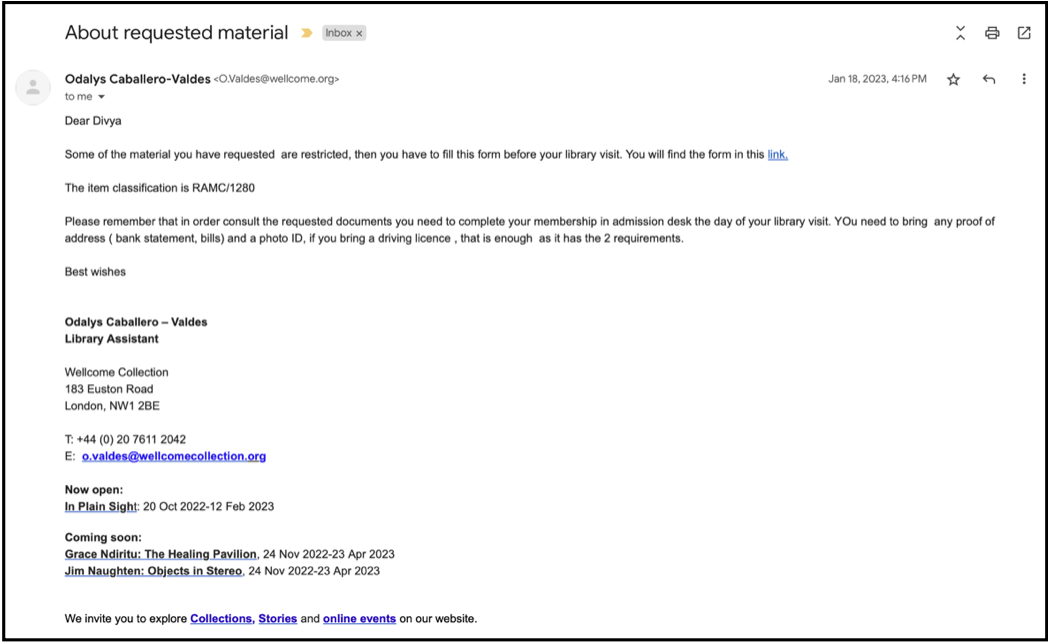
Figure 1. Divya Kishore, Email exchanged (2023), Screenshot.
This holding’s box held a dark orange label, restricting copying and photography. There were three files in this box, all three files were marked with a small dark orange dot, stating “restricted access, until 1 jan 2030.” 11 items in total, 10 note books and 1 set of 3 A3 papers.[3] A diary entry like writing was stumbled upon in one of the note books. It was in the item RAMC 1280/3 Vol. 1, titled ‘Weights, Commenced October 1943.’ A meticulous record of how much every person in the camp weighed. The weights totalled and averaged at the end of each page with red ink. When someone moved the rest of the column was striked out. In case of death, DIED was written in bold. This diary entry like writing was at the end of the book, written in pencil. It spoke about the Christmas celebration in 1944, how it wasn’t to the same scale as the one in 1943. Pointing out the difficulties the Commandant and the Nippon officers had in acquiring supplies. Thanking them for their generosity in acquiring supplies, for allowing the prisoners to hold their religious services. At the very end it spoke about letters from home, halfway through the sentence marks of erasure are visible. It was incomplete, perhaps even a draft of something official.[4]
When looked at for the first time, there were feelings of disgust and anger. How dare they talk about Christmas celebrations when most of Asia was battling Colonialism and atrocities that came with that. This feeling did not allow for a thorougher examination of the rest of the holding. Blatant ignorance of terms like Commandant, Nippon officers, prisoners. Not looking too deeply into the power dynamics. Coupled with the hard to decipher hand writing, attention waned.

Figure 2. Divya Kishore, Library card front (2023), Photograph.
Figure 3. Divya Kishore, Library card back (2023), Photograph.
However, in between this visit and the second visit in May of 2023, the gaps were filled through historical research. This holding was a part of the Sino-Japanese war. Evidence of Japan as a colonial force in Asia. Of the atrocities they orchestrated in between 1931-1945: the Nanking massacre and all the other ones that came after. Comfort Women, bio chemical research conducted through experimentation on humans. Killing that was made a sport, largely ignored till Pearl Harbour and Hiroshima Nagasaki.[5][6] All of this history laid too thickly, making it harder to go back to the archive. It was hard to confront that the prisoners were prisoners of war. In the diary entry, the doctor was referring to everyone in the camp when he mentioned prisoners. It wasn’t an illusive other and the soldiers being rewarded, it was the very soldiers who were prisoners. The binary of colonialism, the illusion of all of Europe as a perpetrator, Asia and Americas as victims somehow lifted. Forcing a confrontation of the making of history for the way history was taught in school for me was only looking at Hiroshima Nagasaki, never understanding that it was in retaliation to Pearl Harbour. Before which Britain and the US did not want to interfere in the Sino-Japanese war for it wasn’t as urgent or important as Germany.[7]
During the second visit, closer attention was paid for this time what was being looked for was known. At the end of the very same note book where the entry was written, there was a note about average weights of the prisoners in the camp. A calculation of the average weight of the new party, 51.0kg, the average weight of the old party, 53.6kg, and the general average, 53.06kg. It was a record of malnourishment.[8]
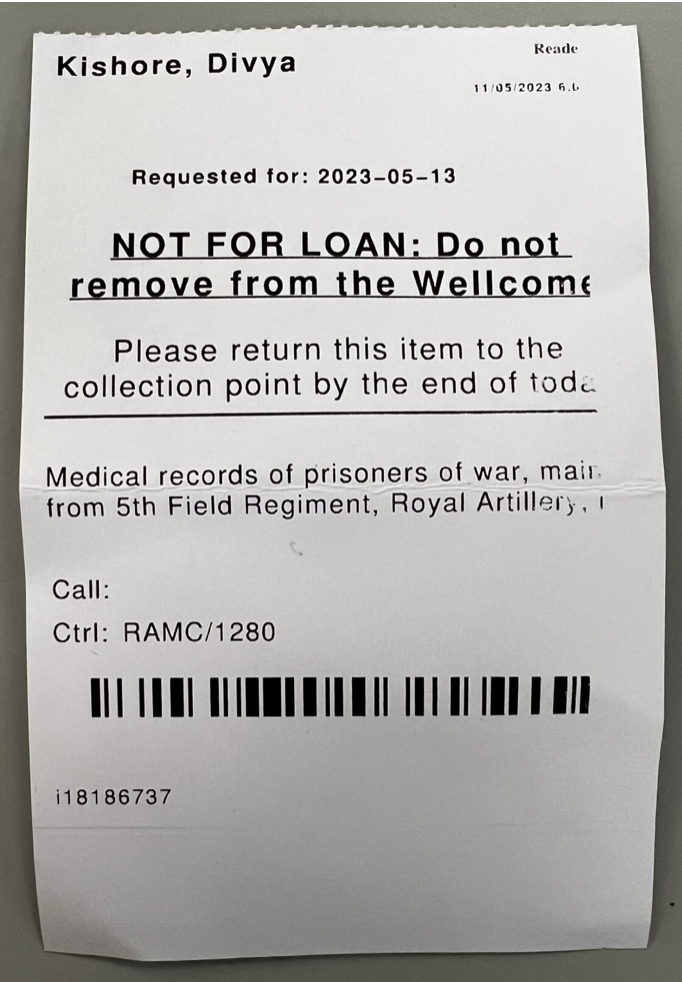
Figure 4. Divya Kishore, Call card (2023), Photograph.
In RAMC 1280/5 II, a note book filled with meticulous medical records, there was a note made at the end of the book. It stated that the patients who were transferred to Taihoku military hospital after their removal from this camp, there was no further case history records available except for in the case of death. In which case a date of death was given, but no final diagnosis.[9]
Most of the cases of death were because of Beri Beri, Diarrhoea, Malaria and Debility according to the medical records in this holding.[10] A sign of lack of clean water, extreme rationing of food, horrible conditions in the camp. These medical records were evidence of brutal histories largely unknown, and unacknowledged.
By the end of these visits the objective changed. The question was of the role that the individual researcher played in the creation of silences. Largely through their own ignorance. Along with the fear of brutal, horrific histories that the archive might hold.
In ‘The Power in the Story’ by Michel-Rolph Trouillot, he says, “… any historical narrative is a particular bundle of silences… .”[11] That silences enter at four stages. Moment of fact creation, fact assembly (making of the archive), fact retrieval (making of the narrative) and of retrospection (making of the story, history in this instance). He speaks about silences not being equal in their inception and their continuation. This is seen in the way the archive collects. The archive collects in abundance, even then there is a standard of collecting that the archive maintains. Allowing for a specific record of history to happen.[12]
One way to combat these silences could be found in ‘Tacit Narratives: The Meanings of Archives’ by Eric Ketelaar. He proposes that the interventions made to the archive by everyone who steps into the archive should also be recorded. Mapping out the archive’s semantic genealogy. This is because the document in the archive doesn’t tell, it shows, inferring it to be evidence of something is up to the person who interprets it. The why’s of the way it was interpreted needs to be recorded for that record might show the privileging and the opposite of some information.[13]
However, both of these writings do not account for how fragmented the histories of war can be. Along with the lesser acknowledged dynamic of the materials holding different value depending on which archive they were retrieved from. The Sino-Japanese war extended from Japan, Russia and China all the way to Singapore. All of those countries already had colonial influences, that means the people residing weren’t only the natives, they were also europeans. When the war ended, the assumption would be that a lot of the documents of the europeans came back to Europe. Along with Japan having burnt a lot of the material themselves to avoid being punished during mid to late 1940s.[14] All of this material would be in different languages, all over the world, scattered. Only held together by this one thread of history which is widely contested for we do not have enough documentation in one place. Further complicating things by Japan’s ardent denial of the scale of the atrocities they committed. Their scholars arguing Japan’s standing on this matter.[15] This history becomes a lesser known history for the Sino-Japanese war isn’t spoken about as much as Nazi-Germany. Nazi-Germany being hailed as the pinnacle of crimes against humanity, even that being cloistered by our own fear of imagining the worst.
The question of who goes in, for what, how do they interpret the material becomes so much more pertinent in this instance. However, would that record be of any use when documentation of this kind is scattered all across the world? Yes, but this material needs to be open access. It cannot go back into the archive. Cannot become one more dusty thing that only comes out when someone goes in to specifically look for it.
Lastly, the question of brutal histories, how do we confront them? It is not a question of how for we must. In ‘Four pieces of Film Snatched from Hell’ by Georges Didi-Huberman, he says that to know we must imagine the hell that was Auschwitz. Not think that it couldn’t be, to shelter, but to imagine. A debt owed to the prisoners.[16] We own a debt to what is contained in the archives, the horrible histories that they contain. We owe it to them to go back, see more clearly, not be sheltered by our assumptions and the privileged narrative of history that is fed to us. Not be blinded by the privileged narrative that the archive might hold as well.
Footnotes
[1] Wellcome Collection, “About us."
[2] Shaw, Collection’s Development Policy 2018-2023.
[3] Royal Army Medical Corps Muniments Collection, 1942-1945, RAMC1280/1 - 8, Box - Medical records of Prisoners of war, mainly from 5th field regiment, royal artillery, in Taihoku Camp, Taiwan, kept by Captain Blair, RAMC, Wellcome Collection Archives, London.
[4] Royal Army Medical Corps Muniments Collection, 1942-1945, RAMC1280/3 Vol I, Box - Medical records of Prisoners of war, mainly from 5th field regiment, royal artillery, in Taihoku Camp, Taiwan, kept by Captain Blair, RAMC, Folder 1, Wellcome Collection Archives, London.
[5] Duncan, “The Pacific War .”
[6] Doglia,“Japanese Mass Violence and Its Victims in the Fifteen Years War (1931-45).”
[7] Doglia,“Japanese Mass Violence and Its Victims in the Fifteen Years War (1931-45).”
[8] Royal Army Medical Corps Muniments Collection, 1942-1945, RAMC1280/3 Vol I, Box - Medical records of Prisoners of war, mainly from 5th field regiment, royal artillery, in Taihoku Camp, Taiwan, kept by Captain Blair, RAMC, Folder 1, Wellcome Collection Archives, London.
[9] Royal Army Medical Corps Muniments Collection, 1942-1945, RAMC1280/5 II, Box - Medical records of Prisoners of war, mainly from 5th field regiment, royal artillery, in Taihoku Camp, Taiwan, kept by Captain Blair, RAMC, Folder 3, Wellcome Collection Archives, London.
[10] Royal Army Medical Corps Muniments Collection, 1942-1945, RAMC1280/1 - 8, Box - Medical records of Prisoners of war, mainly from 5th field regiment, royal artillery, in Taihoku Camp, Taiwan, kept by Captain Blair, RAMC, Wellcome Collection Archives, London.
[11] Trouillot, “The Power in the Story,” 27.
[12] Trouillot, “The Power in the Story,” 1-30.
[13] Ketelaar, “Tacit Narratives: The Meaning of Archives,” 131-141.
[14] Doglia,“Japanese Mass Violence and Its Victims in the Fifteen Years War (1931-45).”
[15] Doglia,“Japanese Mass Violence and Its Victims in the Fifteen Years War (1931-45).”
[16] Didi-Huberman, “Four pieces of film snatched from hell,” 3.
List of Images
Figure 1. Kishore, Divya. Email exchanged. 2023. Screenshot. Source: Screenshot of email sent to Divya Kishore.
Figure 2. Kishore, Divya. Library card front. 2023. Photograph. Source: Picture taken by Divya Kishore of her Wellcome Collection library card.
Figure 3. Kishore, Divya. Library card back. 2023. Photograph. Source: Picture taken by Divya Kishore of her Wellcome Collection library card.
Figure 4. Kishore, Divya. Call card. 2023. Photograph. Source: Picture taken by Divya Kishore of the archive material’s call card.
Bibliography
Didi-Huberman, Georges. “Four Pieces of Film Snatched from Hell.” Essay. In Images in Spite of All: Four Photographs from Auschwitz, 3–17. Chicago: University of Chicago Press, 2008.
Diffen. “World War I vs World War II.” Accessed March 15, 2023. https://www.diffen.com/difference/World_War_I_vs_World_War_II#:~:text=The%20First%20World%20War%20(WWI,between%20different%20groups%20of%20countries.
Doglia, Arnaud. “Japanese Mass Violence and Its Victims in the Fifteen Years War (1931-45).” Sciences Po , October 7, 2011. https://www.sciencespo.fr/mass-violence-war-massacre-resistance/en/document/japanese-mass-violence-and-its-victims-fifteen-years-war-1931-45.html.
Duncan, George. “The Pacific War .” George Duncan’s Historical Facts about World War II. Accessed March 15, 2023. http://members.iinet.net.au/~gduncan/massacres_pacific.html.
History. “Japanese POW Camps during World War Two.” Accessed March 15, 2023. https://www.historyonthenet.com/world-war-two-japanese-pow-camps.
Ketelaar, Eric. “Tacit Narratives: The Meanings of Archives.” Archival Science 1, no. 2 (2001): 131–41. https://doi.org/10.1007/bf02435644.
Medical records of Prisoners of war, mainly from 5th field regiment, royal artillery, in Taihoku Camp, Taiwan, kept by Captain Blair, RAMC. Wellcome Collection, London. https://wellcomecollection.org/works/jvvhq6mm.
Quinn, Joseph. “The British Pows of Hiroshima and Nagasaki, 1945.” The National Archives blog, September 15, 2020. https://blog.nationalarchives.gov.uk/the-british-pows-of-hiroshima-and-nagasaki-1945/.
Sagan, Scott D. “The Origins of the Pacific War.” Journal of Interdisciplinary History 18, no. 4 (Spring 1988): 893–922. https://doi.org/10.2307/204828.
Shaw, Jenny. Collection’s Development Policy 2018-2023. London: Wellcome Collection, 2018.
Trouillot, Michel-Rolph. “The Power in the Story. ” in Silencing the Past: Power and the Production of History, 1–30. Boston, MA: Beacon Press, 2015.
United States holocaust memorial museum. “World War II in the Pacific.” Accessed March 15, 2023. https://encyclopedia.ushmm.org/content/en/article/world-war-ii-in-the-pacific.
Wellcome Collection. “About Us.” Accessed January 10, 2023. https://wellcomecollection.org/about-us.
Wellcome Collection. Access to personal and sensitive information within our collections. London: Wellcome Collection , 2020.
Grades and Feedback
Note: This grade and feedback are for two separate pieces, the first of which is an Archive Report, and the second is an exhibition review. The essay above is the Archive Report section of the assessment.
Grade: 82/100
Graded on: Sunday, 8 October 2023, 9:14 PM
Graded by: Emma Wingfield
Feedback comments: Congratulations on your outstanding work! Both of your texts provide excellent overviews of your chosen archive and exhibition, while also demonstrating your ability to incorporate feedback from your formatives, critically reflect on the Seeing & Showing module, and conduct additional contextual research using diverse sources to enrich your critique (fulfilment). It's particularly commendable how you highlighted the Welcome Collection as an institution that functions both as a collection and an archive.
Throughout your report, you effectively allowed the archive materials to inform your critique, and your close reading of these materials, combined with external research and themes/ideas from the Seeing & Showing module, resulted in a captivating report that delves into the fragmented nature of archives and how we engage with histories from different perspectives and positions of power and privilege (research & analysis).
In your exhibition review, it was impressive to see that you incorporated feedback from the formative assessment, especially in terms of approaching these two exhibitions as separate yet connected entities—one opening up a field of inquiry while the other attempts to critically engage with that legacy (analysis). Your observation regarding the tensions between demystifying museum collections by photographing them for display, while the objects remain in storage, was astute. It highlighted the continued boundary between the object and the audience.
The only aspect to be mindful of is your use of images. Just remember that if you include images, you must reference them in the body of your text to explain why they were included and to provide context (ref. & bib.)
Overall, your work is exceptional, and you should be congratulated on your achievements!
My Reflections
Formative feedback and tutorials should not be ignored. They are essential in the writing process. At least, that has been my experience. Discussing the research and theory with your personal tutor or module tutor can be very helpful in the process. Acting on the feedback constantly improves your grade and your writing, of course.
For this particular module and the essays produced for them, the feedback from Emma and Yaiza (my personal tutor) helped a lot. They both provided me with a reference framework to work from. Emma was also the most detailed when it came to giving feedback on what I was doing wrong. For instance, she was very strict about the proper format for referencing. Even then, this essay contains numerous footnote mistakes that I am learning not to make.
I really enjoyed working on this Archive Report. The tutors always say to write about something we are passionate about; the grade will come automatically. I don’t always agree with that, but in the case of this Archive Report, I very much do. However, enjoying the process needs to happen within the confines of the assessment requirements.